Tropical Pop
Tropical Pop Pragmatic Play Review: Thirty Positions and One Dangerous Pufferfish
Tropical Pop fills a 6×5 screen with smiling sea creatures, then asks a much colder question: how many copies of the same symbol survived the drop? Position does not matter. Adjacency does not matter. Eight matching creatures anywhere on the 30-position board form a win, the winners disappear, and new symbols fall into the empty spaces. The screen may look like a children’s aquarium, but the arithmetic is built around concentration, removal, and repeated evaluations.
The pufferfish explains why the slot becomes far more serious inside free spins. It carries a random multiplier from 2x to 100x. When several pufferfish land during one tumble sequence, their values are added before the sequence total is multiplied. A harmless-looking 2x fish may do little by itself. Two or three large values on the same sequence can change the result at once.
There is also a version problem that many short reviews ignore. Tropical Pop has appeared in standard and Jackpot Play distributions, and public directories frequently combine statistics from the two. Some list 96.48 percent RTP and a 4,000x cap. Jackpot Play documentation commonly lists 95.50 percent for the normal mode, 95.49 percent with Ante Bet, 95.45 percent for a purchased bonus, and a higher maximum that includes jackpot exposure. This review separates the shared reel game from the jackpot layer so the numbers are not treated as universal.
The Aquarium Is Really a Counting Board
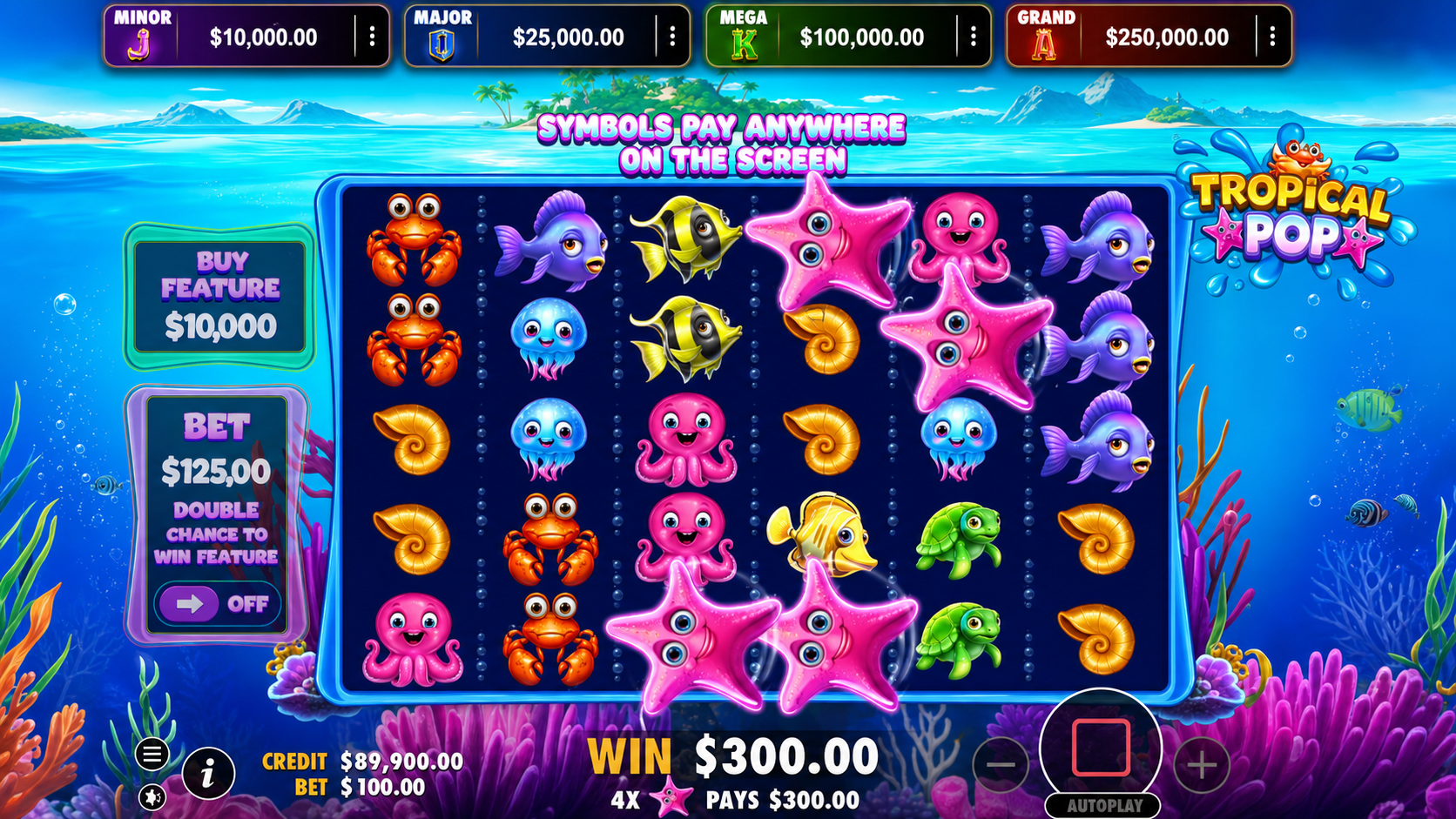
The main grid has six columns and five rows. Tropical Pop may resemble a reel slot when the symbols fall vertically, but it does not use paylines or left-to-right ways. Wins are based on the total number of matching symbols visible anywhere on the screen after an evaluation.
Eight or nine copies reach the first payout tier. Ten or eleven reach the middle tier. Twelve or more reach the top tier. A crab in the upper-left corner and another crab in the lower-right corner count toward the same result. They do not need to touch. This is why describing the system as cluster pays can be misleading. A true cluster rule normally requires horizontal or vertical contact. Tropical Pop’s own introduction states that symbols pay anywhere on the screen.
The difference is not cosmetic. On a cluster grid, a divided group may fail because its sections never meet. Here, all copies are counted together. The important variables are symbol quantity and board composition, not shape. A scattered set of eight jellyfish pays exactly because the game does not care how far apart they are.
Once a qualifying count is found, all symbols belonging to that win vanish. Symbols above the empty spaces drop downward, and replacements enter from the top. The new board is checked again. Another count of eight or more creates a second tumble. There is no stated limit on the number of drops in a single paid spin; the sequence ends only when the refreshed screen no longer contains a qualifying group.
This creates two distinct ways for a spin to matter. The initial 30 symbols may already contain a strong count, or the removal of one species may clear enough room for the next drop to create another. Tropical Pop is less about lining up a picture than about repeatedly changing the population of a small aquarium.
Nine Paying Creatures and a Steep First Tier
The paytable contains nine regular symbols. All values below are measured against the current total bet.
The orange clownfish is the leading regular symbol. Eight or nine pay 10x, ten or eleven pay 25x, and twelve or more pay 50x. That 10x entry value is unusually strong compared with the rest of the cast, so an eight-fish clownfish result already carries real weight without needing a long tumble.
The black-and-yellow fish pays 2.5x, 10x, or 25x across the same three count bands. The golden fish pays 2x, 5x, or 15x. The purple fish returns 1.5x, 2x, or 12x.
The octopus begins the lower half at 1x for eight or nine, 1.5x for ten or eleven, and 10x for twelve or more. The crab pays 0.8x, 1.2x, or 8x. The turtle reaches 0.5x, 1x, or 5x. The jellyfish pays 0.4x, 0.9x, or 4x. The shell closes the list at 0.25x, 0.75x, or 2x.
The gaps between tiers matter. Twelve clownfish pay five times as much as the eight-symbol tier. Twelve purple fish pay eight times the entry tier. Even the shell jumps from 0.25x to 2x. An extra two or four matching symbols can therefore change far more than the visual size of the group.
This also explains why a low starting payout is not always the end of the story. Removing eight shells clears more than a quarter of the board. The immediate 0.25x result is tiny, but the empty positions create room for a second species to fall in. The first win may function as board clearance, with the next evaluation carrying the greater value.
Tumbles Reward Repetition, Not a Rising Base Multiplier
Many modern drop slots attach an automatic multiplier ladder to every successive tumble. Tropical Pop does not need that in the base game. A second or third tumble is valuable because it creates another anywhere-pay result on the same stake, not because a permanent 2x, 3x, or 5x meter automatically rises after each removal.
That distinction changes the pace. A long base-game sequence may contain several separate symbol payments, yet each one is judged through the normal paytable. The round total grows through accumulation. The very large arithmetic is reserved mainly for free spins, where pufferfish multipliers join the grid.
The lack of an automatic base multiplier also keeps the screen readable. Every drop asks the same question: did at least eight copies of any species land? There is no need to track marked positions or remember a multiplier from an earlier stage. Once the sequence stops, the board resets for the next paid spin.
The downside is that long base-game tumbles are not automatically explosive. Three low-tier shell or jellyfish results may animate for a while without producing a large return. The number of cascades and the size of the final prize are related only indirectly. Symbol identity and count remain decisive.
The Pink Starfish Has Two Jobs
The pink starfish acts as the Scatter and pays anywhere, separately from the regular sea creatures. Four starfish pay 3x the bet, five pay 5x, and six pay 100x. Four or more also open the free-spin round.
That jump from five to six is substantial. The sixth starfish does not merely add another copy; it moves the Scatter award from 5x to 100x. It is one of the sharpest paytable steps in the game and gives a six-Scatter trigger value before the free spins even begin.
Four Scatters start the round with 10 free spins. Some later Jackpot Play material lists graduated starting awards for larger Scatter counts, while the widely distributed rules state a standard 10-spin start. This is another point where the live information screen must settle the exact build. The shared rule across the reviewed versions is that four or more Scatters open the round.
Inside free spins, three or more Scatters add five spins. The retrigger threshold is therefore lower than the entry threshold. Scatters also retain their direct payout role, so a retrigger contributes both extra time and a cash result.
There is no fixed maximum retrigger count stated in the common rules. Each set of three or more Scatters may add another five spins while the round remains active. In practice, repeated retriggers are increasingly selective because each one needs another qualifying Scatter screen.
The Pufferfish Changes the Value of an Entire Sequence
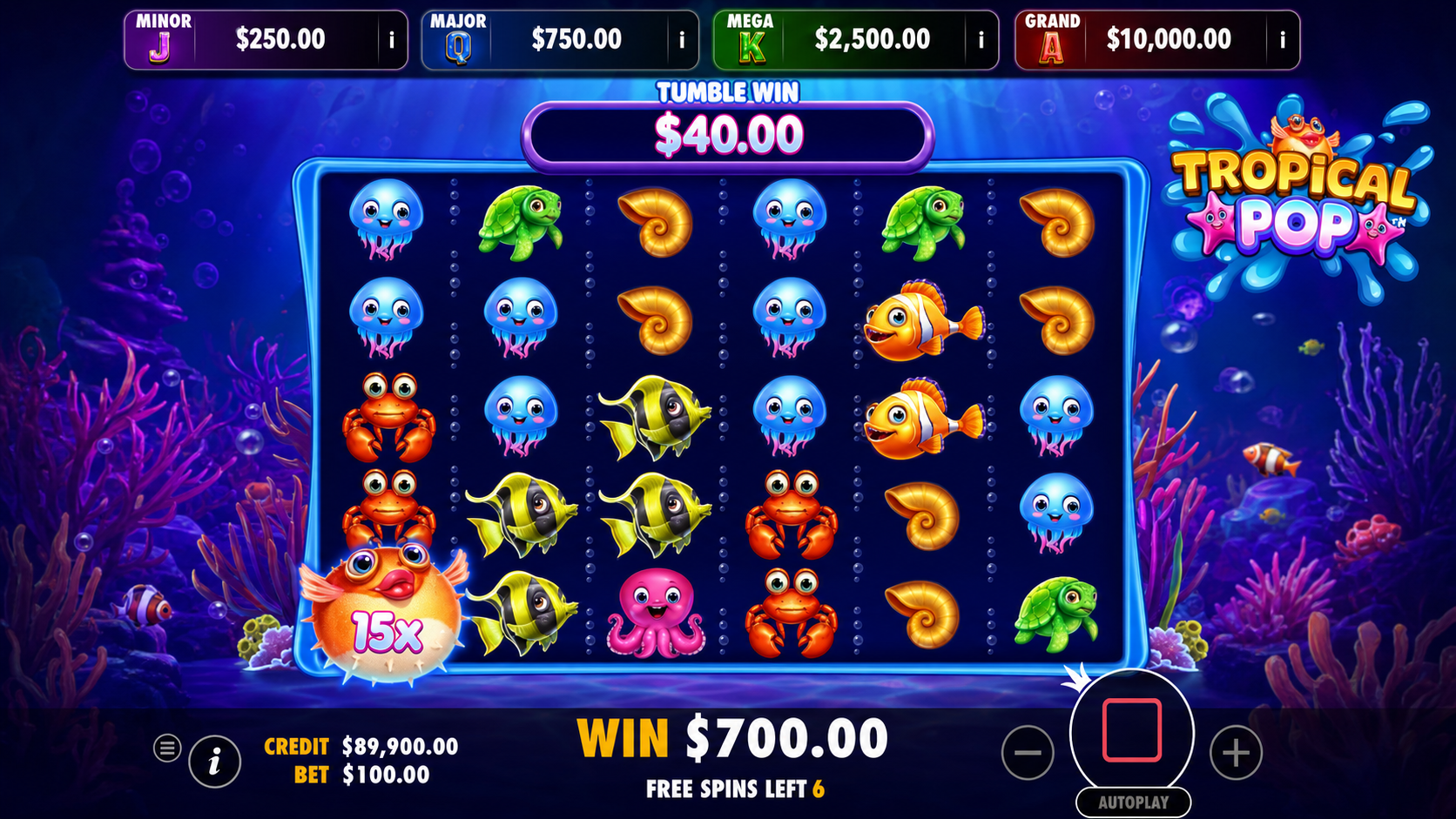
The orange pufferfish Multiplier appears only during free spins. Each one arrives with a random value between 2x and 100x. It remains visible until the current tumble sequence ends.
If one pufferfish is present when a tumble sequence produces wins, the final sequence amount is multiplied by its displayed value. If several are present, their values are added. A 5x fish and a 15x fish therefore create a combined 20x multiplier rather than two separate multiplications. The distinction prevents accidental overstatement: 5 multiplied by 15 would be 75, but the actual combined value in this example is 20.
The multiplier applies to the accumulated win from that sequence. This is why an early pufferfish can matter more than one that arrives at the last drop. When it lands before several anywhere-pay results, those wins join the same sequence total before the final multiplication. A late fish may still raise the amount, but fewer winning evaluations may remain beneath it.
The pufferfish does not have to form a group of eight. It is a modifier rather than a normal paying species. It also stays through the removals instead of disappearing as part of an ordinary matching count. That persistence lets multiple pufferfish share the screen and makes later drops worth watching even when the visible regular-symbol result is small.
The upper value of 100x is powerful by itself. Several multiplier fish can appear in one sequence, so the combined figure can exceed the value printed on any single pufferfish. This is the mathematical center of Tropical Pop. The Scatter opens the round, but the pufferfish determines how far a useful tumble may travel.
Why Timing Matters More Than the Number of Free Spins
Ten starting spins is enough to show the system, but the raw count says little about the likely result. A round with no pufferfish may resemble the base game with free stakes. A round with several multiplier fish can turn one ordinary anywhere-pay sequence into the dominant result of the entire bonus.
Timing divides pufferfish appearances into three rough categories. A multiplier that lands on the opening board is present before the first removal. A multiplier that falls after an early win still has later tumbles available. One that arrives near the end may apply to a completed sequence total, but it has fewer chances to share the screen with another pufferfish or more symbol wins.
The ideal sequence therefore needs several conditions at once: an initial group large enough to start a tumble, enough empty positions to create further groups, one or more pufferfish, and useful multiplier values. A 100x fish cannot multiply a sequence with no qualifying regular-symbol win. A long chain of shells may remain modest under a 2x fish. Large outcomes require the multiplier side and the symbol-count side to meet.
Retriggers add opportunities for that meeting, but they do not raise a persistent multiplier across the entire bonus. Each tumble sequence resolves on its own. A large pufferfish from one free spin does not remain available for the next spin after that sequence ends.
This reset is crucial. Tropical Pop is not a collector bonus where multipliers accumulate for all remaining spins. Its power is compressed into individual sequences. The screen may go from a 100x pufferfish result back to an ordinary starting state on the next free spin.
Ante Bet and Bonus Buy Lead Down Separate Routes
The standard stake mode uses a 20x bet multiplier. Where permitted, the player may activate an Ante Bet that changes the multiplier to 25x. This raises the cost per spin by 25 percent and doubles the stated chance of landing the free-spin round by adding more Scatter symbols to the reel set.
Ante Bet does not make regular symbols pay at a higher rate relative to the total amount charged. Its purpose is trigger frequency. More of each unit staked is directed toward reaching the four-Scatter event. The published return for this mode may also differ slightly from the standard figure.
The Bonus Buy belongs to the normal 20x mode and commonly costs 100x the selected total bet. Purchasing it begins the free-spin round without waiting for a natural trigger. Activating Ante Bet disables the purchase button, so the two routes are alternatives rather than simultaneous upgrades.
This separation is sensible. The standard mode allows either ordinary spins with a purchase option or dearer spins with twice the stated bonus chance. The player is not charged for Ante Bet while also paying the full direct-entry price.
Neither control changes the pufferfish range or the anywhere-pay thresholds. They change the route into free spins. Availability depends on local rules, and some jurisdictions remove autoplay, Ante Bet, Bonus Buy, or all three.
Tropical Pop and Tropical Pop Jackpot Play Are Not the Same Statistical Line
The reel game has circulated under more than one commercial package. The standard Tropical Pop material is commonly associated with a 96.48 percent RTP, high volatility, a stake range beginning at 0.20 and ending at 100, and a 4,000x maximum. Some operator copies list nearby alternative RTP settings.
Tropical Pop Jackpot Play adds four jackpot tiers above the grid: Minor, Major, Mega, and Grand. The jackpot event may interrupt a spin and open a card-selection screen. Matching three cards identifies the awarded tier. The pots may be progressive, so their displayed cash amounts change rather than remaining fixed multiples.
Current Jackpot Play rules frequently show 95.50 percent in standard play, 95.49 percent with Ante Bet, and 95.45 percent when the 100x purchase route is used. Some directories quote a maximum of 21,175x for this package, while others retain a 4,000x figure for the underlying slot exposure. The higher number should not be advertised as a universal cap for every Tropical Pop client.
Volatility labels also vary. The non-jackpot release is often marked high. Certain Jackpot Play documents classify the combined product as medium. That difference may reflect a revised mathematical model, jackpot contribution, or local certification rather than an error in the visible reel rules.
The practical conclusion is simple: the logo alone cannot identify the exact mathematics. A top bar containing Minor, Major, Mega, and Grand confirms the Jackpot Play layer. The help screen then shows the RTP, maximum exposure, stake range, and enabled controls for that particular casino.
This is not a minor footnote. A move from 96.48 to 95.50 changes the long-run theoretical return by nearly one percentage point. A progressive jackpot also diverts part of the model toward a rare event that many sessions will never see.
Reading RTP Without Turning It Into a Promise
RTP represents a theoretical average across a very large number of completed rounds under one configuration. It does not predict the next hundred spins and does not guarantee that a short visit will approach the listed percentage.
Tropical Pop concentrates part of its return in events with several dependencies. A free-spin trigger needs at least four Scatters. The most forceful bonus sequences need pufferfish, meaningful values, and regular-symbol wins in the same tumble chain. Jackpot Play directs another portion toward randomly activated jackpot prizes.
That concentration helps explain why the game may feel rougher than the sea-creature artwork suggests. Many paid spins either fail to reach eight matching symbols or stop after a small entry-tier payment. Larger outcomes arise when removal creates repeated counts or when a multiplier is attached to a useful bonus sequence.
The quoted RTP must also match the chosen mode. Standard spins, Ante Bet, and Bonus Buy may each use a separate theoretical percentage. Switching modes is not merely a change in speed; it can change the mathematical return listed by the client.
The 30-Position Screen Creates Its Own Near Misses
Anywhere pays makes wins easy to understand, but it also makes misses painfully visible. Seven matching turtles scattered across the board look close because only one more is needed. The game does not hide the failed pattern behind a complex payline diagram. It shows the count directly.
The threshold of eight represents more than a quarter of the screen. With nine regular species competing for 30 positions, most random boards contain several small groups and no qualifying count. A win requires one species to become unusually concentrated.
After a group disappears, the distribution changes. Removing eight crabs leaves 22 occupied positions and eight openings. The next symbols may reinforce an existing group or introduce more variety. This is why a tumble is not simply another independent spin. It begins from the surviving board, and survivors may already contain several copies of one creature.
The screen can therefore carry hidden momentum. Five jellyfish that did not pay on the first evaluation remain in place while another species disappears. If three more jellyfish fall, the second evaluation qualifies. The first win cleared space for a group that was already partly assembled.
No player decision controls those falls. Tropical Pop is an RNG slot, and counting symbols does not create a method for altering the result. The value of understanding the rule is interpretive: it explains why a dispersed group pays, why seven do not, and why surviving symbols matter after removal.
A Theme That Fits the Mathematics Better Than It First Appears
The title is literal. Symbols pop out of the aquarium when they win, and replacements drop through the water. Bubbles rise, fish stretch or blink, and the pufferfish inflates around its multiplier value. The theme is not pasted over a conventional payline cabinet; the removal mechanic is part of the visual joke.
Character silhouettes remain distinct on a small screen. The jellyfish is blue and round, the turtle green and low, the crab orange with raised eyes, and the octopus pink with a wide head. The premium fish differ in body shape as well as hue. This matters when the rule asks the reader to count up to eight, ten, or twelve copies at a glance.
The pink starfish is larger and brighter than ordinary symbols, so a possible four-Scatter screen can be read quickly. The pufferfish carries its multiplier across its body in oversized numerals. Neither special symbol is easily confused with the regular paytable.
The audio uses bubbling effects, elastic pops, and short celebratory cues. Each tumble adds another layer without turning every small shell payment into an extended ceremony. During free spins, the tone becomes more urgent as pufferfish land and the sequence total waits for its final multiplication.
The art is deliberately juvenile, which may divide opinion. Players who prefer restrained cabinets may find the wide-eyed fish too sugary. Yet the style serves a mechanical purpose: nine regular species, a Scatter, and a multiplier remain identifiable on a crowded 30-position board.
Phone Layout and Interface Clarity
Tropical Pop naturally suits landscape phone play. The 6×5 grid consumes most of the width, while the title and main spin control sit beside or below it depending on the operator wrapper. The Jackpot Play edition needs extra vertical room for four prize meters, making landscape orientation even more useful.
Symbol counting remains possible because the icons are large and the grid has only 30 cells. Win animations remove every qualifying copy at once, clearly showing which species formed the anywhere-pay result. The empty spaces then refill in a single downward motion.
The bet control, information panel, sound settings, and spin button follow Pragmatic Play’s familiar interface. Bonus Buy and Ante Bet appear as separate controls when local policy permits them. The active mode and total charge should be checked before spinning because the 25x Ante Bet raises the cost above the normal 20x setting.
Jackpot amounts are usually displayed in account currency. Those totals may take substantial space on a small device, but they also make the installed version unmistakable. A screen without the four-tier bar should not be assumed to share the Jackpot Play statistics.
What Tropical Pop Gets Right
The strongest decision is the anywhere-pay rule. It removes arguments about adjacency and lets the full board participate in every count. A player can understand a win by counting one species, even when its members are spread across all six columns.
The tumble system uses survivors well. Non-winning symbols stay on the board, so the next drop has context. A nearly complete group may become a winner after another species clears space. This gives repeated drops a structural connection rather than treating each one as a fresh 30-symbol roll.
The pufferfish is also precise in its purpose. It appears only where the largest arithmetic belongs, carries a visible value, persists for one sequence, and sums with other pufferfish. It does not require a separate wheel or pick screen. The multiplier and the win remain visible together.
Free-spin retriggers use a lower Scatter threshold than entry, giving the bonus a plausible route beyond its first 10 spins. The five-spin addition is large enough to matter without creating an inflated starting round.
Finally, the regular paytable contains meaningful differences. The clownfish begins at 10x for eight copies, while the shell begins at 0.25x. Symbol identity matters as much as count, preventing every anywhere-pay group from feeling interchangeable.
Where the Bubbles Burst
The statistical confusion around different builds is the largest external weakness. A search may return 96.48 percent, 95.50 percent, 4,000x, and 21,175x on pages that all use the same title artwork. A review that lists only one set without naming the edition risks describing the wrong client.
Inside the game, the main weakness is dependence on concentration. Seven matching symbols return nothing as a regular group, even when they occupy nearly a quarter of the grid. Long sequences of sixes and sevens can make the board look busy without creating a payment.
Base-game tumbles lack an automatic rising multiplier. Repeated low-tier groups can generate several animations while the combined result stays modest. Anyone familiar with slots that raise a meter after every tumble may expect a mechanic that is not present here.
The free-spin round can also miss its central idea. Ten spins do not guarantee a useful pufferfish, and a high multiplier does not guarantee a regular-symbol win in the same sequence. The mascot may suggest a light session, but the bonus needs several random conditions to align.
Jackpot Play introduces another layer of distance. Part of the attraction sits in four pots that may trigger randomly. The jackpot bar is always visible, while the actual event may remain absent for a very long period. That imbalance between constant display and rare access is common to progressive systems, but it is especially noticeable above such a cheerful grid.
Final Assessment: Cute Fish, Severe Counting Rules
Tropical Pop is strongest when treated as a counting slot rather than a cluster slot. Thirty positions are checked for eight or more copies of the same regular symbol anywhere on the screen. Winners disappear, survivors stay, and replacement symbols fall until no new group qualifies. That foundation is simple, but the surviving-symbol logic gives each tumble a reason to matter.
Free spins add the part that defines the game’s ceiling. Four pink starfish open 10 spins, three or more may add five, and orange pufferfish attach 2x to 100x values to individual tumble sequences. Multiple pufferfish are summed, making one crowded bonus screen far more important than a long run of ordinary drops.
The design also demands careful version identification. Standard Tropical Pop and Tropical Pop Jackpot Play share the aquarium, symbol counts, tumbles, Scatters, and pufferfish, but they may not share the same RTP, volatility label, maximum exposure, or jackpot contribution. The top prize bar and live help pages settle that question more reliably than the title logo.
As a reel game, Tropical Pop has a clear identity: dispersed symbols count together, low-value wins clear space, and one inflated fish can multiply an entire sequence. The artwork may be soft, but the rules are not. Eight is the minimum, twelve changes the pay tier, four starfish open the bonus, and the pufferfish only matters when the rest of the aquarium produces something worth multiplying.
By Fairy Editorial - 28 Jul 2026

Treasure Trawler
Treasure Trawler Pragmatic Play Review: The Fifth Reel Controls the Entire Catch
Treasure Trawler looks cheerful, but its central idea is surprisingly strict. Treasure Chests appear across the first four reels with cash values printed on them, yet none of that money matters until a Collect symbol lands on reel five. A screen full of chests may end as a near miss. A modest pair of chests may become the start of a much larger chain if the right Collect arrives. The fifth reel is therefore less like an ordinary reel and more like a gate that decides when visible value turns into an actual win.
That structure gives the slot a clear rhythm. Most spins are familiar 20-line reel play, then a chest appears and attention shifts to the far-right column. The bonus round pushes the same tension further by counting Collect symbols toward extra spins and rising multipliers. Pragmatic Play did not build a complicated game here. It built a readable one, then placed nearly all of its pressure on a single reel.
This review examines the reel rules, all five Collect variants, the milestone system, the published 96.54 percent RTP, the 5,000x ceiling, and the parts of the design that feel less original than the beach artwork suggests.
A Fishing Trip Built Around Reel Five
The playfield uses five reels, three rows, and 20 fixed paylines. Standard line wins run from the leftmost reel toward the right on adjacent reels. There is no ways-to-win calculation, cluster grid, or tumbling sequence to decode. A spin settles, the paylines are checked, and any Treasure Chest interaction is resolved when a qualifying Collect sits on the fifth reel.
That old-style frame is important because the chest system needs room to be the main event. Symbols on the ordinary paytable do not compete with elaborate side meters in the base game. Two fish, an anchor, a fishing rod, and four card ranks handle line payouts. The cabinet places the sea behind a battered trawler stranded near shore, while a seagull watches from the dock. It has the light comic tone associated with many Pragmatic Play releases, though the nautical setting is more workmanlike than mythic.
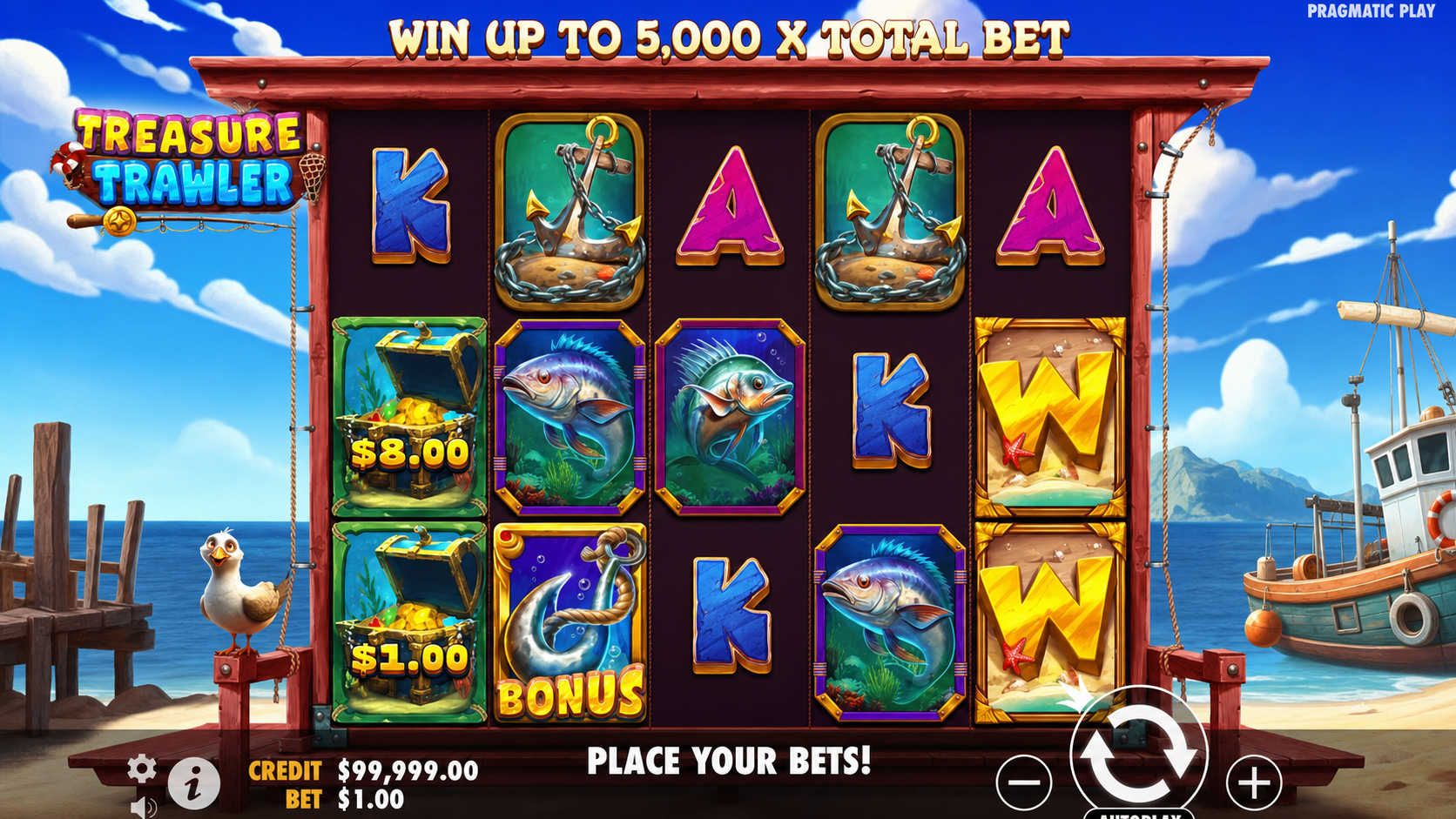
The title screen and reel scene also communicate the rules well. Chests sit only on reels one through four. Collect symbols belong on reel five. Bonus Scatters are confined to reels two, three, and four. Even before opening the paytable, the spatial division is easy to read: value gathers on the left, the trigger waits on the right, and the free-spin key occupies the middle.
This spatial discipline is one of Treasure Trawler’s strongest design choices. It reduces visual confusion when several special symbols arrive together. A chest on reel one never pretends to be a line symbol. A Collect on reel five has an unmistakable job. The player sees both the stored amounts and the conversion mechanism on the same screen.
What the Regular Symbols Are Worth
Treasure Trawler measures its line prizes against the total stake. The blue fish is the leading regular symbol, paying 1.25x, 3.75x, or 12.5x for three, four, or five on a line. The orange fish reaches 0.5x, 2.5x, or 6.25x. The anchor pays 0.5x, 1.5x, or 5x, while the fishing rod pays 0.5x, 1.25x, or 3.75x.
The A, K, Q, and J symbols occupy the lower tier. Five matching letters pay 2.5x. Four A or K symbols return 1x, while four Q or J symbols return 0.75x. Three of any letter pay 0.25x. These are not large figures, and they are not meant to carry the slot. Their purpose is to keep the payline layer active while the chest mechanism supplies the larger changes in pace.
The Wild substitutes for regular paying symbols. In the published rules it does not replace the Bonus Scatter, Treasure Chest, or Collect family. The Wild is visually tied to the fish mascot and may occupy stacked positions, making it more noticeable than the letter symbols. Still, it remains a conventional substitute rather than a spreading or multiplier Wild.
The line-pay ceiling tells us something about the mathematics. A five-of-a-kind blue fish win is useful, yet small beside a high chest value or a multiplied collection. Anyone judging the game only by frequent fish and card matches will miss where the risk is concentrated. Ordinary lines build the floor; Collect events create the peaks.
Treasure Chests Are Promises, Not Wins
Money symbols appear as open Treasure Chests on reels one through four. Their stated values are 1x, 2x, 3x, 5x, 8x, 10x, 12x, 15x, 18x, 20x, 25x, 50x, and 100x the current bet. The printed number makes each chest feel immediate, but it is conditional. Without a Collect on reel five, the displayed amount is not paid merely because it landed.
This distinction drives nearly every emotional turn in the base game. A lone 2x chest and a standard Collect form a small, clean event. Three chests containing 10x, 18x, and 50x create a far more tense look at reel five. If the reel stops without a Collect, the screen is visually rich but financially empty apart from any separate line win.
The design therefore relies on visible near misses more heavily than a conventional payline slot. It repeatedly shows amounts that could have been collected. Some readers will enjoy that transparency because the missed trigger is obvious. Others may find it harsher than hidden mathematics: the game displays the value first and then denies access when reel five fails.
The chest range is broad enough to keep small collections common in appearance while leaving room for occasional jumps. A cluster of 1x and 2x values does little without a modifier. A 50x or 100x chest changes the meaning of even the plainest Collect. The five Collect types exist to vary what happens between those two extremes.
Five Collect Symbols, Five Ways to Resolve the Catch
Treasure Trawler does not rely on a single cash-out symbol. Five Collect variants may appear on reel five, each changing the same group of chest values in a different way.
Standard Collect
The basic version adds the visible Treasure Chest amounts and awards the sum. If the reels show 2x, 5x, and 10x chests, the collected result is 17x before any separate bonus multiplier is considered. This is the cleanest resolution and the baseline against which the other four variants should be judged.
Its plainness is useful. Not every collection needs a second animation or another random step. A high-value chest already creates enough consequence. Standard Collect turns it into money without changing the screen.
Extra Credit Collect
Extra Credit carries its own cash value. That amount is added to the sum of the chests already visible on reels one through four. A weak chest layout can therefore become less disappointing when the Collect symbol itself contributes meaningful value.
This modifier also softens the dependence on filling the first four reels. Standard Collect is only as strong as the chests awaiting it. Extra Credit has a built-in component, so the rightmost reel brings part of the result rather than merely opening the gate.
Multiplier Collect
The Multiplier version multiplies the combined value of the Treasure Chests. Its importance rises sharply when one of the rare upper values is already present. Multiplying several low chests may still create a moderate result; multiplying a 50x or 100x chest is the sort of event capable of moving a session far beyond routine payline returns.
The order matters conceptually: first identify the eligible chest total, then apply the modifier displayed by the Collect symbol. It should not be confused with the persistent free-spin multiplier earned from the top meter. One belongs to a particular Collect resolution; the other changes the bonus round after milestone thresholds are reached.
Expanding Collect
Expanding Collect fills a reel with Money symbols when that reel already contains at least one Treasure Chest. The newly filled positions carry values, giving the collection more material to total. This version is especially interesting when chests are spread across several of the first four reels. A single chest on three separate reels has greater expansion reach than three chests stacked on only one reel.
That creates a rare moment where chest placement matters as much as chest value. With Standard Collect, 5x is 5x regardless of its column. With Expanding Collect, the number of touched reels may influence how many additional money positions enter the result.
Respin Collect
Respin Collect locks the existing Money symbols and respins the remaining positions. It delays settlement, leaving the current chests in place while searching for more. This is the variant with the clearest sense of progression because the first layout becomes a starting board rather than a completed result.
Its value depends on what is already locked and what the respin adds. A crowded screen starts from a stronger base. A sparse screen needs help, but still gains a second chance to place more chests around the held symbols. The precise result remains random; the lock simply preserves what has already been found.
The help screen remains the final authority for unusual overlaps. If more than one Collect symbol appears in a configuration supported by the current build, the on-screen sequence determines the order. It is safer to read the live settlement than to assume that every modifier stacks freely with every other modifier.
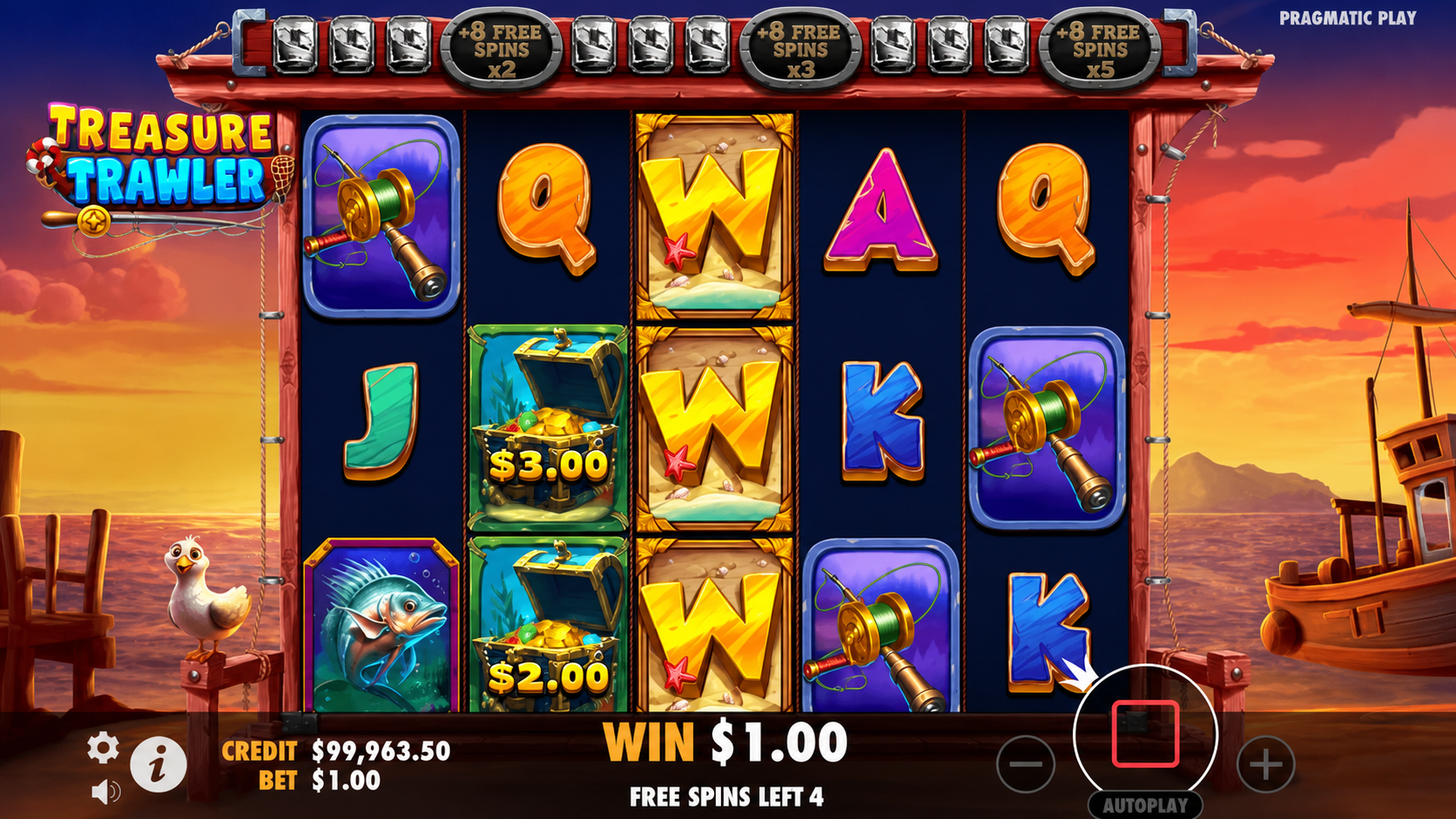
The Bonus Trigger Sits in the Middle
Three Bonus Scatters trigger eight free spins. Unlike a scatter that may land anywhere, these symbols are limited to reels two, three, and four. All three positions are required, which gives the trigger a tidy center-reel pattern. The same three Scatters also pay 1x the total bet.
Eight spins is a short starting round. The real length is decided after entry, not at the trigger. All five Collect variants stay active, and every Collect symbol advances the meter above the reels. That meter has checkpoints after the fourth, eighth, and twelfth Collect.
Reaching four Collect symbols adds eight spins and raises the global win multiplier to 2x. Reaching eight adds another eight spins and moves the multiplier to 3x. Reaching twelve adds a final eight spins and moves it to 5x. The initial eight plus three possible extensions create a theoretical maximum of 32 free spins.
The sequence is well judged because extra time and stronger arithmetic arrive together. The first four Collects do not merely postpone the end; they make subsequent wins more valuable. The second and third checkpoints repeat that logic at steeper levels. A bonus that reaches 12 Collects has survived three separate races against the remaining-spin counter.
Why the Fourth Collect Matters More Than the First
The meter changes how individual symbols feel. In the base game, a Collect is judged mainly by the chests currently on screen. In the bonus, it has two jobs: settle a chest event and advance the round toward a checkpoint. A low-value Standard Collect may be modest as an immediate prize but crucial if it is the fourth symbol and eight more spins are about to be awarded.
That dual role keeps the bonus from being reduced to chest arithmetic. The count can matter more than the amount. The first Collect at the start of a round establishes progress. The fourth alters both duration and multiplier. The fifth begins the next race. The eighth repeats the change at 3x. The twelfth is the final structural upgrade at 5x.
There is also a sharp timing difference between reaching a checkpoint early and reaching it late. An early fourth Collect leaves many spins under the 2x state. A late fourth Collect may rescue the round with eight additional attempts, but much of the opening sequence has already been played at the original multiplier. The same principle applies to the 3x and 5x stages. The meter is not retroactive; the value lies in the spins and collections that occur after the upgrade.
This is where Treasure Trawler creates most of its suspense. The game rarely needs a separate pick screen. The unresolved question is visible above the reels: how many Collects remain before the next marker, and how many spins remain to find them?
Free Spins Can Be Long Without Feeling Loose
The stated 32-spin maximum sounds generous, but it is conditional on reaching all three Collect thresholds. Every extension has to be earned through reel-five appearances. A round that fails to reach four Collects ends after the original eight spins. A round that reaches four but not eight stops after 16. The full sequence needs 12 Collect symbols across the growing pool of spins.
That structure keeps the bonus focused. There is no random wheel interrupting it and no unrelated second meter. Everything points back to the same mechanic introduced in the base game. Treasure Chests gather on the first four reels, Collects resolve them on the fifth, and the meter records how often that relationship succeeds.
The higher multiplier also gives ordinary line wins more relevance during free spins. Fish, anchors, rods, and letters remain on the reels, so the bonus is not purely a cash-symbol hold-and-win game. A stacked Wild can still complete paylines, and the current global multiplier can raise the result. Chest collections remain the more distinctive source of movement, but standard symbol wins do not disappear.
The weakness is equally clear. A round with few Collect symbols can feel abruptly small. Since eight starting spins pass quickly, there may be little time for the system to reveal its upper stages. The distance between the advertised 5x state and a short opening round is considerable. That is not a rules problem; it is the price of placing both extensions and multiplier growth behind the same count.
Published Math: 96.54 Percent RTP and a 5,000x Limit
The listed return-to-player figure is 96.54 percent according to DemoSlot’s Treasure Trawler rules and SlotsTemple’s game page. The slot is generally catalogued at medium volatility, with a maximum win of 5,000x the stake.
The RTP is a long-run theoretical figure for the configured version, not a prediction for a particular visit. Treasure Trawler can produce sequences dominated by low line wins, missed chest collections, or short bonus rounds. It can also compress much of its value into a smaller number of Multiplier Collects or a bonus that reaches the later meter states.
Medium volatility is a reasonable broad label, but it does not describe every part of the game equally well. Regular line prizes are restrained. Chests show a wide 1x to 100x range. Multiplier Collects and the 5x bonus stage create another layer of variation. The base-game surface may feel moderate while the meaningful top-end events remain selective.
The 5,000x cap is high enough for a strong result but below the ceilings now attached to many modern Pragmatic Play releases. That fits the structure. Treasure Trawler is not built around a six-figure multiplier hunt. It aims for readable money-symbol events inside a controlled maximum.
Published stake data is less consistent. Several listings show a range from 0.20 to 100 per spin, while one paragraph on the DemoSlot page mentions 0.10 as the lower end. Casino configuration and currency may also affect the menu. The amount displayed inside the actual game client should be treated as the reliable figure for a specific operator.
No Bonus Buy Means the Base Game Cannot Be Skipped
Treasure Trawler is commonly listed without a Bonus Buy. Access to the free-spin round therefore depends on landing the three center-reel Scatters through normal play. That decision suits the design better than it may first appear.
The base game teaches the chest-and-Collect relationship one spin at a time. By the time the bonus arrives, the player already understands why reel five matters. The bonus then adds only two concepts: a Collect counter and milestone multipliers. A purchase button would separate the most valuable state from the slow introduction that makes it readable.
The lack of a buy option also keeps the base game from feeling like a waiting room around a large button. Chest collections have their own identity outside free spins. Standard, Extra Credit, Multiplier, Expanding, and Respin variants may create worthwhile events before any Scatters align.
There is still a trade-off. Anyone interested only in testing the 4-8-12 meter has no immediate route into it. Bonus frequency becomes a central part of the experience, and a dry stretch cannot be bypassed from inside the slot.
The Uncomfortable Comparison With Clover Gold
Mechanically, Treasure Trawler closely follows Pragmatic Play’s earlier Clover Gold. BigWinBoard’s review describes it as a direct clone in a new skin, and the comparison is hard to dismiss. Both games use five reels, 20 paylines, cash symbols on the first four reels, five Collect types on reel five, eight starting free spins, and milestone upgrades at four, eight, and twelve Collects.
The resemblance does not make the rules worse. Clover Gold already had a coherent collector system, and the fishing theme maps neatly onto the idea of gathering a catch. Yet it limits the sense of discovery for anyone familiar with the older game. The trawler, fish, beach, and Treasure Chests change the atmosphere more than the mathematics.
This matters in a deep review because theme and system should not be mistaken for the same thing. Treasure Trawler has its own artwork and identity, but its core loop is inherited. Newcomers lose nothing from that history. Returning Pragmatic Play users may recognize the entire structure within minutes.
The best argument for this edition is clarity rather than novelty. Chests and Collect symbols make the transaction literal. The first four reels hold the catch; the fifth reel hauls it in. That may be easier to grasp than an abstract pot of coins, even if the underlying sequence is familiar.
How the Presentation Handles Information
The visual design keeps high-value information close to the center. Chest amounts are printed in large numerals. Collect symbols use distinct labels and frames on reel five. The free-spin meter stretches across the top, with the three eight-spin milestones separated clearly. The current number of spins appears along the lower interface.
The sunny base game changes to a warmer sunset during free spins. This is a small but effective cue that the mathematical state has changed. It also helps screenshots from the two modes remain immediately distinguishable. The shift does not cover the reels with extra effects or make low-value symbols hard to read.
Sound follows the same direct approach: reel stops, chest landings, Collect resolutions, and milestone hits carry the emphasis. The soundtrack supports the seaside comedy without trying to turn each standard spin into a major event. Long sessions may still make the loops familiar, but the controls include the usual sound setting.
On a phone in landscape orientation, the five-by-three grid remains legible because there are only 15 positions and the chest numerals are large. The top meter consumes additional height in the bonus, yet the cabinet still reads cleanly. Portrait play depends on the operator wrapper and device, but landscape is the more natural fit for the wide top meter and reel-five focus.
The interface follows the familiar Pragmatic Play layout: stake controls, spin, autoplay where permitted, information pages, and win display occupy the bottom edge. Regional settings may remove autoplay or alter responsible-play controls. Those differences belong to the operator build rather than the core slot.
Where Treasure Trawler Works Best
The strongest part of the game is the relationship between visible value and a fixed collection gate. A player never has to wonder which reel matters after chests appear. Reel five decides. This makes the base game readable without making every spin identical, since the Collect type changes the settlement.
The five variants are also meaningfully distinct. Extra Credit adds its own amount. Multiplier changes scale. Expanding responds to chest distribution across reels. Respin preserves the board and searches for more. These are not five names for the same animation. Each makes a different screen shape desirable.
The bonus meter adds a second reason to care about Collects without introducing a separate symbol family. A tiny collection may still be valuable as the fourth or eighth meter step. That is economical design: one symbol affects the current win, the number of remaining spins, and the future multiplier.
The 96.54 percent listed RTP is competitive for this style of online slot, assuming the casino runs that exact configuration. The 5,000x maximum also keeps the top claim within a range that matches the moderate cabinet and short starting bonus.
Where the Net Comes Up Light
The largest weakness is familiarity. Anyone who has played Clover Gold has effectively seen the mechanical blueprint. Treasure Trawler changes the setting, not the core calculation. The fishing theme is well matched, but it does not add a fresh rule.
The visible-chest system can also make failed spins feel sharper. Several printed cash amounts may land without a Collect, leaving the player to watch obvious potential disappear. Some slot designs hide that missed value inside probability. This one places it directly on the reels.
Eight starting free spins may end before the milestone structure gains momentum. The game advertises three extensions and a 5x state, but access depends on repeated Collect landings. A bonus that ends before four Collects shows only the opening layer of the design.
Regular line wins lack much personality once the chest system is understood. The fish and fishing equipment fit the setting, but their payouts mainly fill gaps between Collect events. There is no Wild modifier or alternate payline rule to make that layer deeper.
Finally, public directories disagree about the minimum stake. That does not change the mathematics, but it means a review cannot promise the exact lowest bet across all casinos and currencies. The live client should settle that question before play begins.
Final Verdict: A Clear Collector Slot With a Familiar Hull
Treasure Trawler succeeds because its main rule can be understood from the reel layout. Treasure Chests occupy reels one through four, five Collect variants wait on reel five, and three center-reel Scatters open a bonus where every collection also advances a 4-8-12 meter. The system is easy to follow yet capable of producing materially different outcomes through Extra Credit, Multiplier, Expanding, and Respin resolutions.
Its best moments come when two kinds of progress meet. A useful chest layout receives the right Collect, and that same symbol reaches a meter checkpoint for eight more spins and a higher multiplier. The player gets an immediate result and a better mathematical state for the remaining round.
Its limitations are just as plain. The eight-spin opening can finish quickly, visible chests often vanish uncollected, standard paylines rarely command attention, and the framework is closely inherited from Clover Gold. The beach setting changes the mood but not the underlying voyage.
For readers who value transparent collection rules, a fixed 20-line grid, and a bonus that grows through earned checkpoints, Treasure Trawler is a disciplined piece of slot design. For those already familiar with Clover Gold or searching for a wholly new Pragmatic Play system, it may feel like a repaint of a dependable boat. The fifth reel still makes every chest screen worth watching, and that single gate remains strong enough to carry the trip.
By Fairy Editorial - 28 Jul 2026

Rock Beauty
Rock Beauty JILI Review: Five Respins, One Heart Board, and a 1250x Finish
Rock Beauty has the look of a conventional music slot until three red gemstone Hearts appear. At that point the reels stop behaving like ordinary reels. The Hearts stay in place, five free respins begin, adjacent Hearts merge into larger rectangular blocks, and the completed shapes receive their own multipliers when the round ends.
That geometry is the part worth studying. A screen with many isolated Hearts can be weaker than a screen with fewer symbols arranged into one tall rectangle. A 5x2 block and a 4x3 block do not share the same multiplier range even though both occupy a large portion of the grid. Filling all 15 positions creates the 5x3 Heart board and places the 1250x top result within reach.
JILI wraps that system in a neon rock concert. A pink-haired guitarist acts as the Wild, speakers and instruments fill the regular reels, and the bonus gems resemble stage jewellery. The cabinet looks light and familiar, but the Heart round has more structure than the usual five-spin bonus.
The concert stage is only the frame
Rock Beauty uses a five-reel, three-row cabinet with 25 fixed paylines. The background resembles a small arena stage: steel lighting trusses frame the reels, blue spotlights sweep across the sides, and the symbols glow like neon signs against dark reel strips.
The title character appears with magenta hair, a black rock outfit and an electric guitar. She is not part of a narrative sequence or a character-selection system. Her practical role is the Wild symbol, while her full-body artwork establishes the concert identity around the cabinet.
The ordinary symbol set stays close to the theme. A red electric guitar sits at the top of the regular paytable, followed by a purple drum, a blue speaker and a green vintage microphone. Neon A, K, Q, J and 10 symbols fill the lower-paying positions.
The red Heart gemstone is different from every instrument. It does not work as a standard paying symbol, and the Wild cannot replace it. Three or more Hearts move the result into a separate collection round with five free respins.
This separation keeps the base game readable. Instruments and card ranks belong to paylines. The pink-haired portrait repairs line combinations as a Wild. Hearts belong to the bonus grid. The cabinet does not ask one symbol to perform several unrelated jobs.
Twenty-five lines govern every ordinary spin
Base-game awards begin on the leftmost reel and run through consecutive reels toward the right. Matching symbols must follow one of the 25 fixed line patterns. Scattered instruments across the grid do not pay merely because three copies are visible.
Only the highest award on each payline is counted. A single screen may pay across several different lines, but overlapping possibilities on the same line do not stack into several separate prizes.
The rules express a line result as Pay multiplied by Bet divided by 25. This matters because the numbers printed in the symbol paytable are tied to the 25-line structure rather than acting as direct total-bet multipliers.
At a total bet of 25, Bet divided by 25 equals one. A five-guitar line listed at 250 therefore pays 250 currency units. At a total bet of 2.50, the same line becomes 25 units because the line stake is 0.10.
This old-style calculation may look unfamiliar to users accustomed to modern paytables written entirely in total-bet multipliers. The safest reading is to treat every base-symbol number as a line-pay value and the Heart Bonus values as total-bet multipliers. Mixing the two scales produces exaggerated estimates.
The regular paytable has a steep top tier
The red guitar is the strongest ordinary symbol. Three guitars pay 25 line units, four pay 50 and five pay 250. The last matching guitar multiplies the four-symbol value by five, so most of the guitar line value sits behind a complete run across all five reels.
The purple drum follows at 20, 40 and 200 for three, four and five. The microphone and speaker share values of 15, 30 and 150. Both again reserve most of their value for the fifth matching symbol.
The neon A pays 10, 20 and 100. K, Q, J and 10 each pay 5, 10 and 50. There is no difference among those four lower ranks, even though their colours make them look like separate value classes.
These values explain why the Wild portrait matters outside the bonus. A Wild placed on the fifth reel can complete a 250-unit guitar line or a 200-unit drum line. The same portrait replacing a lower card rank has a much smaller effect.
The Wild substitutes for all regular symbols but not the Heart. Several public directories tag Rock Beauty with expanding symbols, yet the rules available for the reviewed build only confirm substitution and a comparatively high Wild appearance rate. The real base-game promotional screen shows stacked Wild portraits, but that is not enough evidence to claim that every Wild expands to cover an entire reel.

The reconstructed base-game image above follows the genuine Rock Beauty cabinet and symbol sheet. It keeps the original five-by-three layout, blue reel strips, 25-line structure and stacked Wild presentation while extending the stage to a full-width editorial crop.
Three Hearts replace paylines with persistence
The publicly mirrored Rock Beauty bonus rules and paytable state that three or more Heart symbols in the main game start five free respins. The Hearts responsible for the trigger remain locked on the board. New Hearts that appear during the feature also stay until the round finishes.
This makes position more important than it was in the base game. A regular guitar needs a left-to-right payline. A bonus Heart needs useful neighbours. Hearts that touch in the required rectangular arrangement merge into a larger block, and the block size determines the multiplier range used at settlement.
The five respins are a fixed starting allowance, not a reset-to-five mechanic. A new Heart does not automatically restore the counter. The separate +1 Spin tile is the disclosed method for adding another bonus round.
That distinction places Rock Beauty closer to a persistent collection feature than a standard Hold and Win game. Hearts lock, but the round does not use the familiar three-respin reset. There are no printed cash values on individual gems, and no Mini, Minor, Major or Grand jackpot labels.
The aim is not to total a group of coin amounts. The aim is to build rectangles. Once a qualifying block forms, its dimensions identify the multiplier band that will be resolved after the bonus.
The board remembers Hearts but not the extra-spin tile
Locked Hearts survive from one respin to the next. A Heart occupying reel two, row one remains there while empty cells spin again. If new Hearts fill connected cells beneath or beside it, the game can join them into a larger rectangle.
The +1 Spin tile behaves differently. It adds one round when it appears, then disappears on the next spin after taking effect. It is not retained as a permanent occupied cell.
This temporary behaviour is important near the end of the bonus. A +1 tile buys another chance to land a Heart but does not itself contribute to the final rectangle. It may also occupy a cell for the current result where a Heart would have been more useful.
The visual contrast helps. Hearts use faceted red gemstones with a silver border. The extra-spin tile uses a bright text panel. One is stored value through geometry; the other is time.
There is no disclosed retrigger from landing another group of three Hearts. The round length changes through +1 Spin symbols, not through a fresh Scatter count. Describing every new Heart as an extra respin would therefore be inaccurate.
Rectangle size is more important than raw Heart count
The bonus paytable begins with simple single-column shapes. One Heart pays 1x total bet. A vertical 1x2 block pays 3x, and a complete 1x3 column pays 5x.
Once a shape reaches two columns and two rows, its multiplier becomes random within a published range. A 2x2 block pays from 8x to 20x. Both 2x3 and 3x2 shapes pay from 15x to 40x.
A 3x3 block raises the range to 50x through 100x. A 4x2 block pays 30x through 60x, while a 5x2 block pays 100x through 250x.
Height carries unusual weight at the upper end. A 4x3 block pays 250x through 500x, even though it uses 12 cells. A 5x2 block uses 10 cells but pays only 100x through 250x. Adding vertical coverage and reaching all three rows is worth far more than simply stretching a two-row band across the fifth reel.
The full 5x3 board pays from 500x through 1250x. This is not 15 isolated one-times Hearts added together. The completed rectangle replaces the small-cell interpretation with a much larger block multiplier.
A 4x3 block can beat a wider 5x2 shape
The multiplier bands make the geometry easier to understand through comparison. Ten Hearts arranged as 5x2 fall within a 100x to 250x band. Twelve Hearts arranged as 4x3 fall within 250x to 500x. The second pattern uses only two additional cells, yet its minimum equals the first pattern’s maximum.
The same effect appears lower down. Eight Hearts forming 4x2 receive 30x to 60x. Nine Hearts forming 3x3 receive 50x to 100x. Completing the third row again moves the shape into a stronger class.
This does not mean the user chooses where new Hearts land. Reel outcomes remain random. The comparison explains why two bonus screens with similar symbol counts can finish with very different awards.
It also explains the sharpest near-miss. A board may fill two entire rows across all five reels and stop as a 5x2 block. That is a substantial 100x to 250x result, but the empty third row keeps the screen away from the 500x to 1250x full-board band.
The bonus therefore creates its tension through missing cells rather than through visible cash amounts. A single gap can divide what appears to be one large group into smaller rectangles, or prevent a two-row shape from gaining the third-row multiplier class.
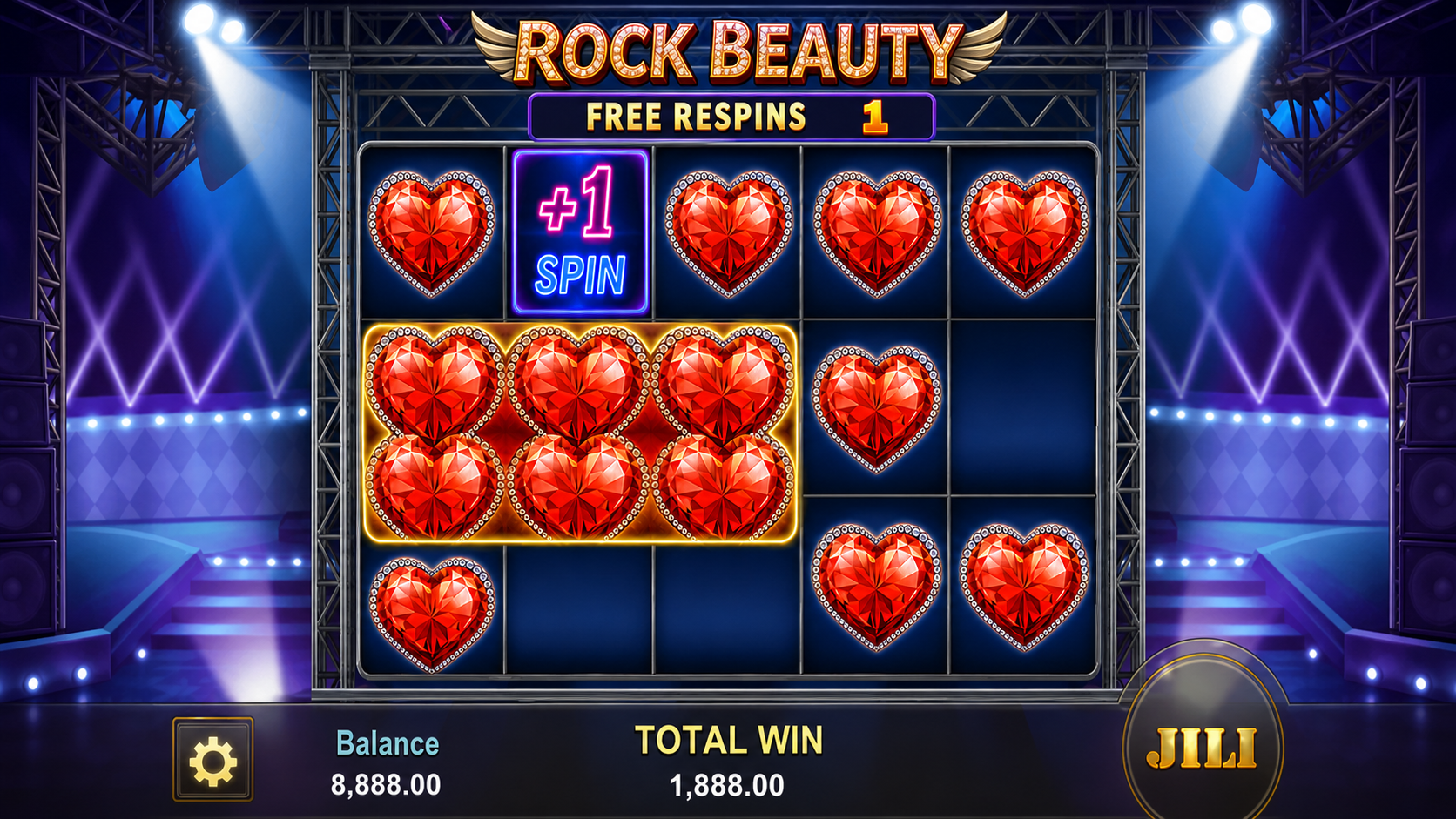
The bonus reconstruction uses the genuine Heart design and original cabinet proportions. It depicts an in-progress round rather than a claimed real-money outcome: locked gems occupy the grid, a 3x2 block has formed, one free respin remains, and the temporary +1 Spin tile has appeared.
Settlement happens after the respins
The locked board is not fully valued every time a new Heart appears. The feature preserves its shapes through the remaining rounds, then larger blocks of at least 2x2 enter a random-prize settlement at the end.
That delayed resolution prevents the displayed total from behaving like a simple running coin counter. A 3x3 block has a known range of 50x to 100x, but the precise multiplier inside that band is not determined by the shape alone.
The full 5x3 rectangle follows the same principle. Completing the board opens the 500x to 1250x range. It does not state that every full board automatically pays 1250x.
The distinction is essential in promotional writing. The maximum board creates a chance at 1250x. It is not a fixed 1250x prize. The lower boundary for the same shape is 500x.
Smaller shapes have fixed results where the paytable prints one number. A single Heart is 1x, 1x2 is 3x and 1x3 is 5x. Random ranges begin with the 2x2 rectangle.
The completed bonus can contain more than one separate block if gaps prevent all Hearts from merging into one rectangle. The exact live rules screen determines how each distinct block is recognised and settled. A review should not invent an algorithm for irregular L-shaped groups when the published paytable only illustrates rectangles.
The 1250x ceiling belongs to the Heart board
The strongest regular line is five guitars at 250 line units, but the advertised top multiplier is tied to the 5x3 bonus board. JILI’s official thumbnail prints 1250x, and the bonus paytable assigns a 500x to 1250x range to a full Heart grid.
Several directories also list 1250x as the maximum. A localized field on one JILI information page displays 1200x while the same page describes combined Hearts reaching 1250x. The official artwork and detailed Heart table support 1250x, making the 1200x field look like a transcription error rather than a separate mechanic.
Rock Beauty has no progressive jackpot meter. The maximum is a multiplier of the current total bet, not a shared prize pool that grows across many accounts.
At a total bet of 1, the top figure corresponds to 1,250 currency units. At a total bet of 10, it corresponds to 12,500. Local currency formatting may change, but the multiplier relationship stays the same unless the operator runs another mathematical build.
The maximum should not be confused with a likely session result. It sits behind a complete 15-cell Heart rectangle and the top end of that rectangle’s random multiplier range.
Five starting respins create a short, stateful round
Five respins sound brief, but each locked Heart changes the board for every round that remains. An early Heart has more time to acquire useful neighbours than one landing on the last respin.
The counter does not need a long series to create a visible progression. The first screen establishes several anchors. Later rounds either fill spaces around those anchors, place isolated gems elsewhere, produce a temporary +1 tile or leave the board unchanged.
An early 2x2 rectangle can grow into 3x2, 4x2 or 2x3 depending on where subsequent Hearts appear. A nearly complete third row can move a wide shape into the stronger three-row bands.
Isolated Hearts are not entirely wasted because even a single gem carries 1x, and later placements can connect to it. Their weakness is relative. Several scattered 1x cells do not approach the value of one compact upper-tier rectangle.
This gives the feature a clear visual logic without a second set of spinning reels. Empty cells show what is missing. Locked cells show what has been secured. The shape itself communicates the possible payout class.
The Wild portrait never becomes a Heart
The pink-haired Rock Beauty portrait replaces guitars, drums, speakers, microphones and card ranks in standard line awards. It explicitly excludes the Heart symbol.
That exclusion keeps the bonus trigger exact. Two Hearts and one Wild do not count as three Hearts. A Wild beside a 2x2 locked block cannot enlarge the rectangle. Only genuine Heart symbols participate in the persistent grid.
Public gallery images show the portrait appearing in stacked positions. This can support several lines at once because one reel position may belong to multiple fixed paths. It still remains a regular substitution symbol rather than a bonus collector.
The boundary also prevents the base game’s most visible character from distorting the Heart mathematics. Bonus progress depends on red gemstone positions, while line repair depends on the portrait.
Directories that describe expanding Wilds may be referring to stacked portrait appearances or another client revision. No detailed rule source reviewed here confirms a guaranteed full-reel expansion. The live information panel should settle that point for the selected casino build.
Published RTP figures need a version label
SlotCatalog lists Rock Beauty at 97% RTP with medium variance, a 0.10 to 100 stake range and a 1250x maximum. Several mirrored slot directories repeat those values.
Other casino articles publish 95.99% or roughly 96.7%. The official JILI Rock Beauty page describes the layout, Heart mechanism and maximum but does not display an RTP percentage in its public summary.
There is no sound reason to average those records. A blended figure would not correspond to any confirmed mathematical build. For the directory version reviewed here, 97% is the most widely repeated listing, but the in-game help menu at the active casino has priority.
At 97%, the theoretical house margin is 3% over the full mathematical model. That percentage includes routine paylines, Wild-assisted lines, Heart triggers and rare upper-tier rectangles. It does not describe the result of a short set of spins.
Operator configuration and regional distribution can account for differing RTP records. The article page should retain the version context instead of presenting 97% as a universal number attached permanently to the title.
The release date has two plausible meanings
JILI’s own product page identifies 2019 as the publishing year. Some independent directories record December 6, 2021 as the release date, while their page-update history extends into 2023.
The difference may reflect the original studio release versus the date a directory or distribution channel added the HTML5 build. JILI’s 2019 record is the stronger source for first publication. The 2021 date remains useful when identifying the particular indexed version found in casino catalogues.
This age explains several interface choices. Rock Beauty uses fixed lines, a visible line-bet formula, a large dedicated Autospin panel and a cabinet designed around a single landscape screen. It predates the current trend of bonus-buy menus and multi-level coin jackpots.
The official compatibility list includes Windows, Android, Mac and HTML5. A directory that marks the title as unavailable on mobile conflicts with JILI’s own record and with the responsive client design. That mobile warning appears to be outdated.
Medium variance does not describe every bonus outcome
Medium variance is the common directory classification. It fits a base game where 25 lines and Wild substitution create routine line activity while the 1250x ceiling remains concentrated in a rare full-board event.
The Heart feature can still produce a wide range of endings. A few isolated gems may settle at small fixed multipliers. A compact 3x3 block reaches 50x to 100x. The last row of a 4x3 or 5x3 shape moves the result into a much higher band.
That spread does not automatically turn the entire product into a high-variance slot. Volatility describes the complete distribution of all results, including frequent base lines and small Heart shapes.
Hit frequency is not published in the sources reviewed. It should not be estimated from the 25-line count, because more paylines do not reveal how often the reel strips create an award.
The trigger rate for three Hearts, the probability of +1 Spin and the chance assigned to each random multiplier inside a block range are also undisclosed. Stating exact rates for those events would go beyond the available rules.
Landscape view makes the Heart geometry easier to read
The cabinet was built around a wide stage. On desktop, the entire 5x3 board remains large enough to inspect while the respin counter and controls stay outside the grid.
Mobile compatibility is part of the official specification, but a narrow screen reduces the apparent size of each Heart and makes merged borders harder to distinguish. Landscape orientation gives the bonus more room and preserves the concert framing.
The interface uses strong visual separation. Reel strips are dark blue, regular symbols glow in distinct neon colours, and Hearts use red facets with a silver edge. Locked groups receive a brighter border when they merge.
The sound design follows the stage setting with guitar-driven cues and crowd-like accents. Regular spins use short loops, while Heart landings add sharper impact sounds. The audio identifies state changes, although repeated base spins can make the loop feel dated.
The large Spin and Autospin controls reflect the game’s age but remain easy to locate. Balance, total bet and win occupy separate panels across the bottom rather than hiding inside a compact menu.
What still works after several years
Rock Beauty gives the bonus a visible mathematical identity. The user does not merely collect more red objects. Shape dimensions lead to defined payout bands, and the third row matters far more than its three extra cells initially suggest.
The 25-line base game also supports the theme rather than competing with it. Guitars and drums sit at the top of the paytable, while the central character acts as Wild. There is no unrelated ancient temple, coin pot or jackpot wheel attached to the concert.
Five starting respins keep the special round compact. Locked Hearts create enough persistence to build anticipation without turning the feature into a long sequence of nearly identical reel stops.
The full-board target is immediately understandable. All 15 positions filled by one merged Heart shape means the top multiplier band has been reached, even though the final number still falls between 500x and 1250x.
The absence of a bonus purchase keeps every Heart round connected to the main reels. There is no separate price menu or altered trigger mode to explain.
Where the design shows its age
The base game has little activity beyond fixed-line wins, Wild substitutions and the Heart trigger. Users accustomed to cascades, symbol upgrades or several random modifiers may find the ordinary spins plain.
The line-pay formula also needs explanation. Pay multiplied by Bet divided by 25 is less immediate than a modern total-bet multiplier printed beside every symbol.
Several public records conflict on RTP, release date and the expanding-Wild label. The official trial link for the old game now redirects to the broader JILI catalogue, making version verification harder than it is for newer titles.
The bonus rules use awkward translated wording around the end-of-round random prize. The illustrated block table is clearer than the prose, but irregular Heart arrangements still require the live help screen for definitive settlement details.
The maximum board is visually simple but statistically opaque. No public rule source states the probability of receiving 1250x instead of 500x after filling all 15 cells.
Final reading of Rock Beauty
Rock Beauty is best understood as two games sharing one cabinet. The first is a traditional 25-line music slot where guitars, drums and a pink-haired Wild create left-to-right awards. The second is a five-respin geometry game built entirely from locked Heart gemstones.
Three Hearts open the second system. New Hearts remain on the 5x3 board, compatible positions merge into rectangles, and a temporary +1 Spin tile can extend the round. The finished shapes receive fixed multipliers at the smallest sizes and random multiplier bands from 2x2 upward.
The important thresholds are not based only on symbol count. A 5x2 block pays 100x to 250x, while a 4x3 block pays 250x to 500x. Filling the complete 5x3 grid reaches the 500x to 1250x band.
That structure gives an older JILI release a reason to be examined rather than merely remembered for its pink-haired guitarist. The stage art creates the identity, but the third row of the Heart board determines how loud the finish can become.
By Fairy Editorial - 28 Jul 2026

Coin Nonet Lightning
Coin Nonet Lightning JILI Review: The Growing Coin Stack Does Not Improve Your Odds
Coin Nonet Lightning builds its entire identity around a simple division of labour. Coin values land on the first four reels. A lightning fist lands on the fifth. The coins may look valuable while they sit on the grid, but none of them are collected until that final-reel symbol arrives.
The feature is easy to recognise and easy to misread. Gold coins also accumulate in a pile above the reels, giving the impression that the game is moving toward a guaranteed lightning event. The product rules say otherwise. The pile may rise alongside a possible Rising Lightning trigger, but its size does not change the probability of that trigger.
That sentence is more important than the large jackpot boards or electrical animation. Coin Nonet Lightning is not a meter-building slot in which patience steadily improves the next-spin odds. The pile is a visual record linked to the feature presentation, while every random trigger remains random.
A note about the JILI label before discussing the game
Coin Nonet Lightning is placed under JILI Games by SlotCatalog and under JILI.US by SlotsMate. That explains why many casino lists and search pages call it a JILI title.
The downloadable Coin Nonet Lightning product sheet, however, carries TaDa Gaming branding and identifies SlotMatrix as the distributor. The most careful description is therefore that Coin Nonet Lightning appears in some JILI or JILI.US catalogues, while its production sheet identifies TaDa Gaming.
This review retains the JILI wording because that is how the title may appear in a casino lobby, but all mechanical figures below come from the version 1.0 product sheet. The distinction matters because one JILI.US review page lists 96% RTP and medium-high volatility, while the product sheet and SlotCatalog entry both list 94.07% RTP and low volatility.
Those values should not be mixed into a fictional average. The live information panel at the selected casino remains the final version check, especially if a lobby applies a different studio label or market configuration.
Twenty lines hiding inside a classical temple
The cabinet uses five reels and three rows with 20 fixed paylines. Regular line awards begin on reel one and move through adjacent reels from left to right. Three or more matching symbols are normally required.
This is a line slot, not a 243-way game and not a cluster game. Several identical fruits can appear close together without paying if they do not follow one of the 20 printed paths. The payline screen therefore has practical value rather than existing as an old-fashioned menu page nobody needs.
The symbol set is deliberately conventional. Cherries, lemons, oranges, plums, grapes and watermelons occupy most reel positions. A 777 symbol acts as the Wild and sits at the top of the regular paytable. Dollar signs surrounded by a laurel wreath act as Scatters. Prize Coins, Jackpot Coins and the fifth-reel Collect fist belong to the cash-collection system.
The setting places these familiar fruit-machine elements inside a marble temple under a pink storm sky. Greek-style columns and electrical arcs suggest Olympus, yet there is no named god or unfolding myth. The temple is a stage for the coins rather than a narrative location.
The product sheet supports both 16:9 and 9:16 aspect ratios. On desktop, the reel cabinet sits in the centre with columns and clouds filling the sides. On a phone, the same elements stack vertically, with the jackpot board and coin pile above the reels and controls beneath them.
The first four reels hold value and the fifth decides access
Prize Coins appear only on reels one through four. Their displayed amounts correspond to multipliers of the current bet. Public gameplay material shows values beginning at x0.5 and reaching x10 for standard Prize Coins.
The Lightning Collect Coin appears only on reel five. When it lands with one or more Prize Coins visible on the first four reels, the game gathers those values into a cash award. A coin without a Collect symbol remains unclaimed even if its printed number is large.
This one-sided arrangement makes reel five structurally different from every other reel. Reels one through four build a possible total. Reel five either activates that total or leaves it sitting on screen until the spin clears.
Suppose the first four reels show x0.5, x1, x3 and x5 Prize Coins. Their combined value is x9.5. A Collect fist on reel five turns that visible sum into a payout equal to 9.5 times the current total bet, subject to the exact multiple-collector and maximum-win rules in the active paytable.
Without the fist, the same coin arrangement pays nothing through the Collect mechanic. The coins do not lock for a later spin and they are not a stored wallet. Each base-game screen is evaluated on its own.
That distinction separates Coin Nonet Lightning from Hold and Win games. There is no three-respin counter, no sticky coin grid and no reset caused by a new coin. The core event occurs inside one ordinary reel result.
A Collect symbol is valuable because of what sits to its left
The fist has no universal value by itself. Its worth depends on the coin field created by reels one through four. A Collect beside one x0.5 coin is a small event. The same fist beside several Prize Coins and a Grand Jackpot Coin can reach the game ceiling.
Location on reel five also matters when more than one Collect symbol appears. Promotional gameplay shows several fists filling the final reel while multiple coins remain visible to the left. This suggests a screen where the same coin field is collected more than once or otherwise receives a larger award under the multiple-collector calculation.
The short text in the game sheet describes a specialised Collect symbol gathering all visible coin values but does not spell out the complete formula for two or three simultaneous Collect symbols. The live paytable should be treated as authoritative for that edge case. It would be careless to invent a multiplication rule from animation alone.
The maximum figure settles the upper boundary. The product sheet lists a 3000x maximum multiplier. At the published maximum bet of 100, the corresponding maximum exposure is 300,000. No combination of fists, Prize Coins and Jackpot Coins pays beyond that cap in this version.
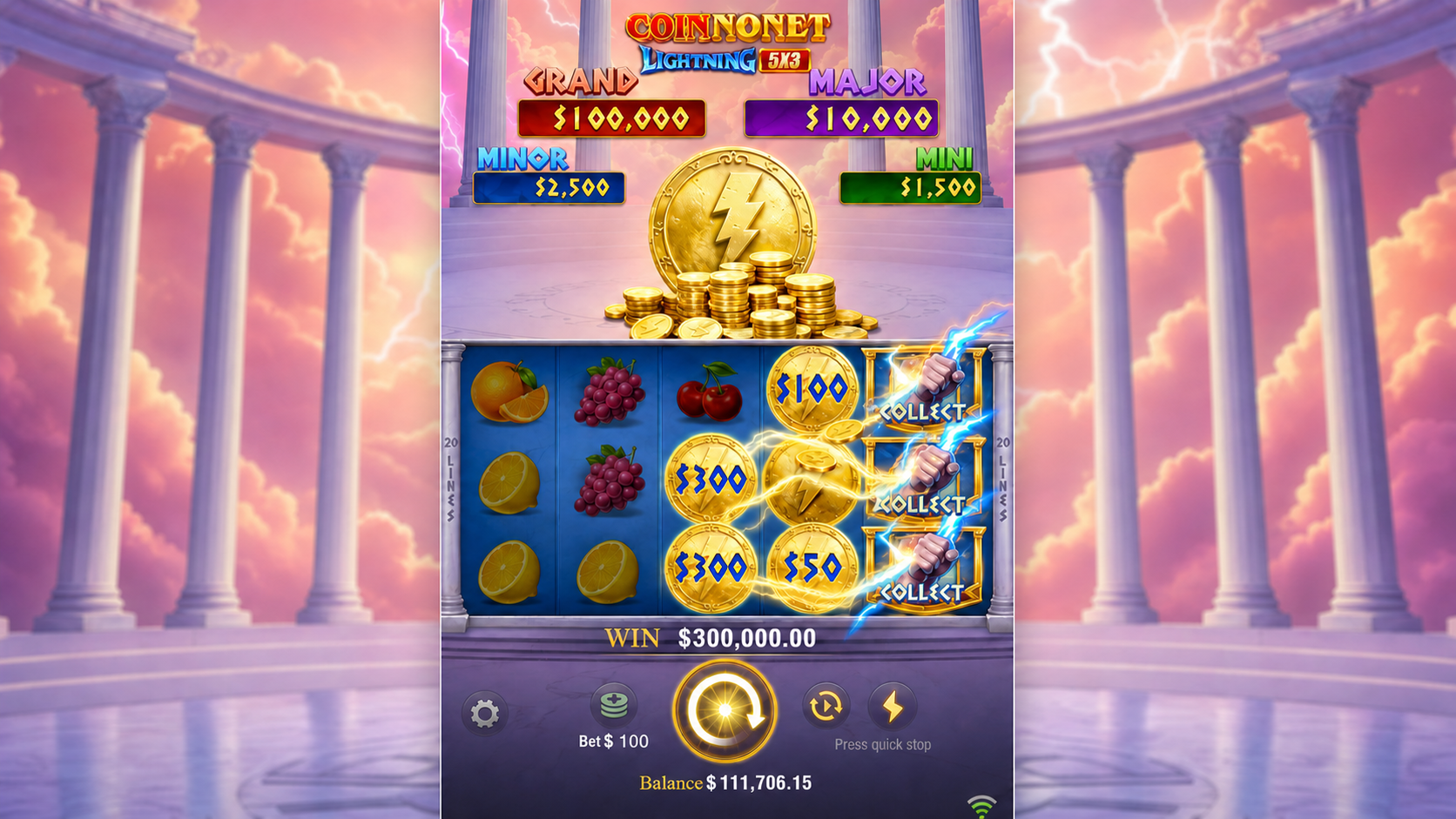
The reconstructed collection screen above follows the official promotional layout: standard coins remain on reels one through four, lightning fists occupy reel five, and the fixed jackpot values scale with a 100 stake. The displayed 300,000 amount matches the published maximum exposure rather than exceeding it.
Standard Prize Coins are only the lower layer
Jackpot Coins also appear on reels one through four. Instead of a small multiplier, each carries one of four fixed jackpot tiers: Grand, Major, Minor or Mini. These awards still need the Collect symbol on reel five.
At a 100 bet, the product screenshots display:
Grand at 100,000, equal to 1000x the current bet.
Major at 10,000, equal to 100x.
Minor at 2,500, equal to 25x.
Mini at 1,500, equal to 15x.
The cash amounts change with stake, while the implied multipliers remain the useful comparison. These are in-game fixed jackpots rather than a progressive pool shared across casinos. The Grand does not grow because other users have placed more bets.
A jackpot label landing on reels one through four is still conditional value. The Grand image may dominate the screen, but it is not paid until the fifth reel supplies Collect. This mirrors the ordinary Prize Coin rule and keeps all cash symbols dependent on the final column.
That dependence produces the sharpest near-miss in the game. A Grand Coin can sit visibly on the grid while reel five stops on fruit. The image looks like a jackpot event, but mathematically it is an uncollected symbol.
The reverse near-miss also exists. Reel five may show one or more Collect fists while the first four reels contain no Prize Coin or Jackpot Coin worth gathering. The trigger symbol has arrived, but there is no meaningful total attached to it.
Rising Lightning adds coins but is not a progress guarantee
Whenever Lightning Coins appear, the presentation adds them to coin stacks positioned above the reels. As those stacks rise, the Rising Lightning feature may trigger randomly. If it activates, as many as 12 Lightning Coins are inserted onto the reels.
The word may is decisive. The product sheet explicitly states that the size of the coin stacks does not affect the probability of triggering Rising Lightning. A tall stack is not closer to activation than a short stack in any measurable way disclosed by the game.
This prevents a common visual assumption. Many slots use a growing object as a true collection meter, with each addition moving the user toward a threshold. Coin Nonet Lightning uses growth as theatre around a random event. The pile may make the cabinet look charged, but it does not create accumulating trigger equity.
Up to 12 added coins can transform the reel state because only 12 positions exist across reels one through four. In the most crowded case, every available non-Collect position may receive a coin. Reel five remains reserved for the fist, so even a full wall of values still needs collection access.
The feature can add both ordinary Prize Coins and higher-value coin types according to promotional descriptions. The resulting screen may contain a much larger sum than a standard reel stop. Yet the same final dependency survives: values on the left need a Collect symbol on the right.
Rising Lightning therefore changes quantity, not the rule hierarchy. More coins increase the amount available to gather. They do not remove reel five from the calculation, and the growing stack above the grid does not force the feature to appear.
Why up to 12 extra coins can still result in no collection
Imagine Rising Lightning fills ten of the twelve positions across the first four reels. The total printed value may be substantial. If reel five finishes without a fist, none of those ten cash symbols is collected.
This outcome can feel harsher than an ordinary blank spin because the screen has displayed value in explicit numbers. Fruit symbols merely imply possible paytable awards; Prize Coins show exactly what appears to be waiting. The fifth reel decides if that value becomes real.
The design uses this contrast as its main source of tension. The event is not about keeping coins alive through several respins. It is about loading one side of a single result, then checking if the access symbol appears on the other.
Multiple Collect symbols create the opposite extreme. A dense coin field paired with a full final reel of fists is the kind of arrangement capable of reaching 3000x. The maximum remains rare even in a product classified as low volatility because volatility describes the total payout distribution, not the ease of reaching the cap.
The Rising Lightning rule is also why the game does not need Free Spins. Its spectacle comes from injecting extra values into the current spin and resolving them immediately. There is no second reel mode or separate bonus counter to manage.
The Scatter pays cash rather than opening Free Spins
Coin Nonet Lightning has a Scatter, but it does not start a free-spin round. Three, four or five Scatter symbols appearing anywhere pay a direct bonus based on the current bet.
The official values are:
Three Scatters pay 5x.
Four Scatters pay 20x.
Five Scatters pay 500x.
Scatter positions do not need to follow a payline and do not have to start on reel one. Five Scatters can occupy any five visible cells and still create the 500x award.
The leap from 20x for four to 500x for five is intentionally steep. The fifth Scatter does not merely add another small step; it multiplies the previous tier by 25. That gap turns the final symbol into a major part of the 3000x potential even without a free-spin feature.
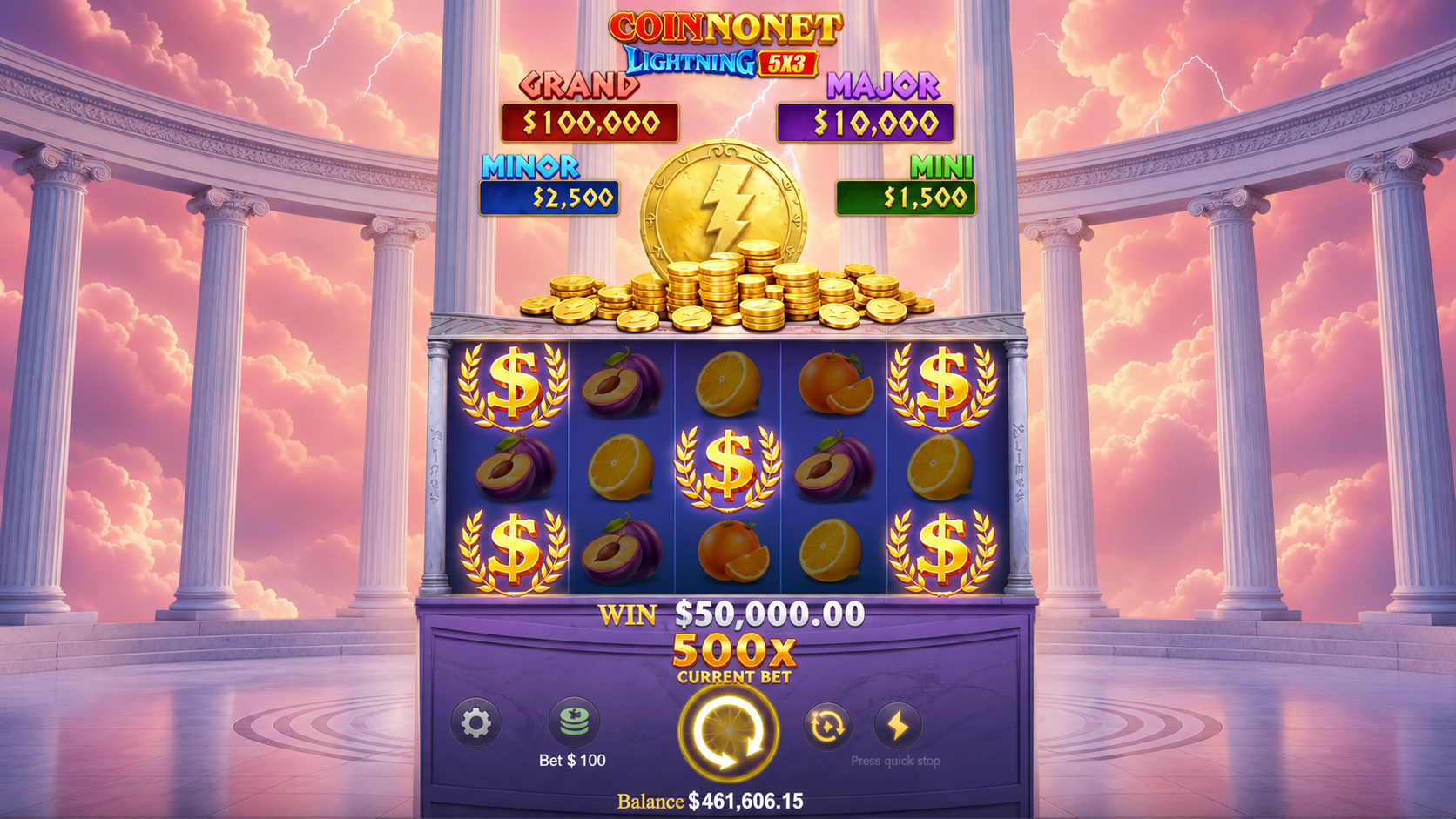
The five-Scatter reconstruction shows the direct award correctly. There is no remaining-spins counter because the 500x prize resolves on the same result. Reviews that describe three Scatters as a Free Spins trigger are confusing this game with another coin title.
Scatter and collection awards can occupy the same thematic cabinet, but their conditions differ. Scatter pays from symbol count anywhere. Lightning Coins depend on values to the left and Collect on reel five. Keeping those systems separate makes the rules much easier to read.
There is no Free Spins safety net
The product sheet marks in-game Free Spins as no. It also marks Buy Into Bonus and promotional Free Spins as no. The cash-collection system and Scatter prize are the full bonus structure.
This absence changes the session rhythm. There is no period where the original stake buys a fixed sequence of additional reel results. Every new base-game spin is another paid spin, and every special event resolves inside that spin.
The lack of a bonus purchase also means the main mechanic cannot be reached through a menu shortcut. Rising Lightning, Prize Coins and Collect fists all remain part of the ordinary reel model.
Some users may prefer this direct structure because every feature is visible on the main cabinet. Others may find it repetitive because there is no alternate background, expanding grid or bonus-only multiplier progression.
The Scatter wording deserves care in SEO copy. Calling it a bonus symbol is accurate. Calling it a Free Spins Scatter is not. Three Scatters pay 5x as an instant prize rather than opening a round.
The Wild still matters when no coins appear
The 777 Wild replaces standard paying fruit symbols in line combinations. It is also the highest-paying regular symbol, listed at 2x, 20x and 50x for three, four and five on a one-unit line reference.
Watermelon follows at 1x, 4x and 20x. Grapes and plums reach 10x for five. Oranges, lemons and cherries reach 5x. Exact cash awards scale with the selected bet and the 20-line structure.
Because the slot has a 14.74% listed hit frequency, regular line wins carry more importance than the low-volatility label might suggest. The coin mechanic is visually dominant, but many spins are still decided by fruit and Wild combinations.
Wild does not substitute for Scatter, Prize Coins, Jackpot Coins or Collect. Those symbols have specialised positions and independent evaluation rules. A 777 on reel five cannot act as a Collect fist, and a Wild beside a Grand Coin does not cash it out.
The best regular line runs from reel one through reel five, following one of the 20 paths. Five Wild symbols create the highest single-symbol line value, though the game-level 3000x ceiling depends on larger special-symbol outcomes rather than the 50x Wild pay alone.
A 14.74% hit rate can coexist with low volatility
The product sheet lists a 14.74% hit frequency. Expressed as a simple reciprocal, that is roughly one counted hit per 6.8 spins over the mathematical model. It is not a timed schedule and does not mean every seventh spin must win.
Low volatility does not automatically mean a high hit frequency. Hit rate measures how often the model records qualifying awards. Volatility concerns how results are distributed around the average and how heavily rare large outcomes shape that distribution.
A game may record fewer hits but keep many of those hits within a narrower range, while another may pay more frequently yet reserve a large share of return for rare extreme events. The two labels answer different questions.
Coin Nonet Lightning still has a 3000x ceiling and a 1000x Grand tier, so low volatility should not be translated into guaranteed small swings. It is a relative classification supplied by the product sheet.
The 14.74% figure also counts all qualifying outcomes under the model, including fruit lines, Scatter awards and collection events according to the studio methodology. It should not be interpreted as the frequency of Rising Lightning or Collect specifically. Those individual rates are not published in the sheet.
The listed RTP is 94.07%, not a blended 95% figure
The version 1.0 product sheet lists RTP at 94.07%. SlotCatalog repeats the same number. A JILI.US review page lists 96%, but that page also assigns different volatility and stake limits, indicating either an earlier record, a mismatched version or a separate market configuration.
The correct editorial approach is to publish the figure attached to the reviewed build and mention the conflict. Averaging 94.07% and 96% would create a number that belongs to no actual game version.
RTP describes the long-run theoretical return of the entire model. It includes regular line wins, Scatter awards, coin collections, Rising Lightning results and rare jackpot outcomes. It does not forecast a personal session.
At 94.07%, the mathematical house margin is 5.93% before any external casino promotion is considered. That is simply 100 minus 94.07. The figure needs no claim that it is balanced or suited to a particular skill level.
The game information menu inside the active casino should be checked if it displays a different percentage. Operator configuration, jurisdiction or distribution channel may explain why JILI.US and SlotMatrix records do not match.
From 0.10 to 100 changes the jackpot board, not the odds display
The published stake range is 0.10 to 100. Jackpot cash values scale with the current bet. At 100, the product images show Grand 100,000, Major 10,000, Minor 2,500 and Mini 1,500.
At one tenth of that stake, the cash displays should scale to one tenth if the multipliers remain 1000x, 100x, 25x and 15x. The precise currency formatting depends on the casino client.
Changing stake alters the cash amount attached to each multiplier but does not create evidence that Rising Lightning becomes more likely. The product sheet discloses no stake-based trigger adjustment.
The maximum exposure of 300,000 is tied to the maximum 100 stake multiplied by the 3000x cap. At a 1 stake, the same cap is 3,000 in currency units. Maximum multiplier and maximum cash exposure should not be treated as two separate jackpot promises.
Peso-facing versions may display a converted or locally configured range. The amounts visible in the product sheet use US dollars and identify the planned market as New Jersey. A Philippine-facing lobby may use different currency labels while keeping the multiplier structure.
What the interface communicates well
The cabinet separates each function vertically. Fixed jackpot tiers sit at the top. The coin pile occupies the middle display area. Reels appear below it, and the stake controls sit at the bottom.
Prize Coins use large printed numbers, so their available value is readable before reel five stops. The Collect fist is visually different from every gold coin: a hand grips a lightning bolt inside a framed fifth-reel symbol.
Electrical arcs trace the path from the Prize Coins toward Collect during an award. That animation explains the mechanic without a text box. Values originate on the left and are pulled toward the right.
The four jackpot colours remain consistent. Grand is red, Major purple, Minor blue and Mini green. Jackpot Coins on the reels use the same labels, reducing the chance that a Mini symbol is mistaken for a generic cash coin.
The possible weakness is the stack above the reels. Its growth resembles a probability or threshold meter even though the rules reject that interpretation. The cabinet communicates coin accumulation more strongly than it communicates randomness.
Where the design holds together
Coin Nonet Lightning keeps its rule hierarchy stable. Cash values come from the first four reels, access comes from the fifth, and random Rising Lightning events add more values without changing the collection condition.
The jackpot system uses the same grammar as ordinary Prize Coins. A Grand is simply a much larger conditional value waiting for Collect. There is no need to learn a separate wheel or pick game.
Scatter also stays self-contained. It counts anywhere, pays 5x, 20x or 500x, and ends. The absence of Free Spins prevents confusion between the cash-collection system and a second bonus mode.
The 20-line fruit foundation gives the cabinet a purpose when special coins are absent. Cherries, grapes and 777 symbols still create ordinary results, so the base game is not made entirely of waiting for a fist.
The product sheet is unusually direct about the misleading stack. Stating that stack size does not affect trigger probability is useful disclosure and should be repeated in any serious review.
Where the lightning loses force
The main disappointment is repetition. Every major event resolves on the same 5x3 screen. There are no Free Spins, no Hold and Win sequence, no bonus purchase and no progressive jackpot pool.
Rising Lightning may place many values on the screen and still leave them uncollected. This is mathematically consistent, but the display of explicit coin amounts can make a no-Collect result feel more severe than a normal losing spin.
The coin stack creates a false sense of progress unless the rule page is read. A larger pile looks closer to an event despite having no disclosed effect on the trigger probability.
Studio naming is another practical weakness. JILI, JILI.US, TaDa Gaming and SlotMatrix appear across public records. A backend article that names only one without qualification may be accurate for its casino lobby but inaccurate about original production branding.
RTP records also conflict across directories. The 94.07% product-sheet build should be distinguished from pages claiming 96%. A copied specification list can easily combine the RTP from one record, volatility from another and stake range from a third.
Final reading of Coin Nonet Lightning
Coin Nonet Lightning is not a Hold and Win slot wearing a different skin. It is a one-spin cash collector. Reels one through four create visible value, reel five grants access, and each result clears after evaluation.
Rising Lightning may add up to 12 coins, but it does not guarantee a Collect fist. The pile above the reels may grow, but the product sheet says its size does not improve the chance of triggering the feature. Those two facts define the game more accurately than the jackpot artwork does.
The direct Scatter awards add a second route to larger results: 5x for three, 20x for four and 500x for five. There is no Free Spins round behind them. Regular fruit lines and a 777 Wild fill the gaps between special-symbol events.
For the reviewed version, the published figures are 94.07% RTP, low volatility, 14.74% hit frequency, stakes from 0.10 to 100 and a 3000x maximum. Public JILI.US records showing 96% appear to refer to a different or mismatched listing.
The JILI label may be the correct lobby category for the site publishing the review. The underlying product sheet still bears TaDa Gaming branding through SlotMatrix. Keeping both facts visible is more accurate than forcing the game into a single attribution.
The final judgment rests on the fifth reel. Everything to its left may look valuable, and the pile above may look ready, but neither becomes a payout signal until the lightning fist appears. Coin Nonet Lightning turns that single dependency into the whole game.
By Fairy Editorial - 28 Jul 2026

Dim Sum Mania
Dim Sum Mania Review: Every Reel Has a Price After the Spin
Dim Sum Mania appears to be a light food slot built around steamed buns, tea and a busy Cantonese restaurant. The cheerful dining room is only half the story. Once the reels stop, five small prices appear below the grid. Each price belongs to a different reel, and paying it spins that reel again while the others stay in place.
That second decision is the real game. A normal spin reveals the symbols, but the result may also create a partly completed combination, two Free Spins symbols or a promising stack on the first reels. Dim Sum Mania then asks if one frozen screen is worth modifying through a paid single-reel respin.
Pocket Games Soft released the title on August 13, 2020. The cabinet uses five reels, three rows and 243 ways. Listed RTP is 96.75%, volatility is medium, the regular stake range is 0.25 to 25 credits, and the advertised maximum is 20,000 times the bet. These figures are recorded on the Dim Sum Mania listing at SlotCatalog, while the actual rule screens explain the less obvious details behind the paid respin system.
The bill arrives after the main spin
Many slots place their main choice before the reels move. Dim Sum Mania reverses that order. The paid spin finishes first, the game exposes the whole grid, and only then does it show five reel-specific respin buttons.
This timing changes the nature of the decision. The extra cost is attached to a visible position rather than an unknown starting screen. Four reels remain fixed, so the likely purpose of each available respin is apparent. Reel five might be the only gap in a five-reel symbol chain. Reel three might hold the Wild that links both sides. Another screen might show two Free Spins symbols, leaving one required for the bonus.
The five prices need not match. In the captured game screen, the displayed reel costs are 0.17, 0.39, 0.40, 0.73 and 0.32 on a 2.50 base spin. The in-game rules state that each reel price is calculated separately. They also make a point that the amount does not indicate a greater or smaller chance of winning.
That warning matters. A price of 0.73 is not proof that the fifth reel is more likely to land the missing symbol than a reel priced at 0.17. The amount belongs to the mathematical value of changing that part of the current position, not a visible probability meter.
A 243-way grid that still starts on the left
The 5-by-3 format creates 243 possible symbol routes because each of the five reels has three positions. Three multiplied by itself five times equals 243. This does not mean every matching group anywhere on screen pays.
A standard combination starts on the leftmost reel and moves through adjacent reels. A symbol on reels two, three and four is not enough if the same symbol is absent from reel one. Gaps also break the chain. Reels one, two and four cannot form a valid route without a match or Wild on reel three.
The number of winning ways for one symbol is calculated by multiplying its matching positions across the connected reels. If two copies land on reel one, one lands on reel two and three land on reel three, the screen contains six three-reel ways for that symbol. Another matching position on reel four would keep all six paths alive. Two matches on reel four would raise the count to twelve.
This multiplication is why a single-reel respin can matter. Replacing one column may affect many routes at the same time. It may extend several existing three-reel ways to reel four, or it may destroy an unhelpful column and insert a Wild that supports different symbols.
The game uses a fixed base-bet structure of 25 units for its 243 ways. Bet size runs from 0.01 to 0.10, while bet level runs from 1 to 10. The normal 0.25 minimum follows from 25 multiplied by a 0.01 bet size and level 1. The 25-credit maximum follows from 25 multiplied by 0.10 and level 10.
That structure explains why 243 ways do not require 243 separate line stakes. The displayed total bet is based on 25 base units, while the symbol routes are evaluated through the ways calculation.
Food symbols do more than decorate the cabinet
The regular symbol set is split between card ranks, several dim sum dishes and two diners. J, Q, K and A sit at the low end. Dumplings, siu mai, spring rolls and plated dishes occupy the middle. The young woman and bespectacled man are the premium character symbols.
The male character is the highest regular symbol. The paytable lists 10, 40, 400 and 4,000 units for two through five consecutive reels. The woman pays 5, 25, 250 and 2,500. The basket of steamed buns reaches 2,000 for five reels, while spring rolls reach 1,000.
These values are not automatically cash amounts. The in-game rules multiply the listed symbol value by bet size and bet level, then multiply again by the number of winning ways. Several copies of the same premium symbol across consecutive reels can therefore create many routes at once.
The food artwork helps the grid more than the restaurant story does. White steamed buns sit on purple tiles, yellow siu mai sit on blue, and fried rolls use green. Those tile colours separate similar beige and gold dishes on a small phone screen. The dishes remain identifiable even when the reels move quickly.
The diners beneath the reels give the cabinet a little motion between spins. An elderly woman stacks bamboo baskets, a man works behind the counter and a younger woman stands at the right. They make the paid respin row feel like part of a working restaurant counter rather than an abstract control strip.
The Wild belongs to the middle of the meal
The porcelain teapot is the Wild. It replaces every standard paying symbol but does not replace the Free Spins Scatter. According to the in-game rules, it appears on reels two, three and four only.
This is worth stating because several secondary reviews say the Wild appears only on reels two and four. The actual game-rule page includes reel three as well. That middle position is especially valuable in a ways slot because it can connect symbols from the first two reels to matching symbols on reels four and five.
The Wild never appears on reel one, so every regular way still needs a natural symbol at the start. It also cannot land on reel five, which means a five-reel route needs the target symbol naturally on the final reel. The Wild improves the interior of a chain but does not remove both endpoint requirements.
A Wild on reel three may support several symbol types simultaneously. If reels one and two already contain both dumplings and spring rolls, the same teapot position may substitute inside routes for each group. The ways system then counts each symbol independently.
There is no Wild multiplier in the normal game. The teapot is valuable because of substitution and route multiplication, not because it attaches an extra numerical factor. The flat x3 belongs to Free Spins and applies to the finished win rather than to the Wild itself.
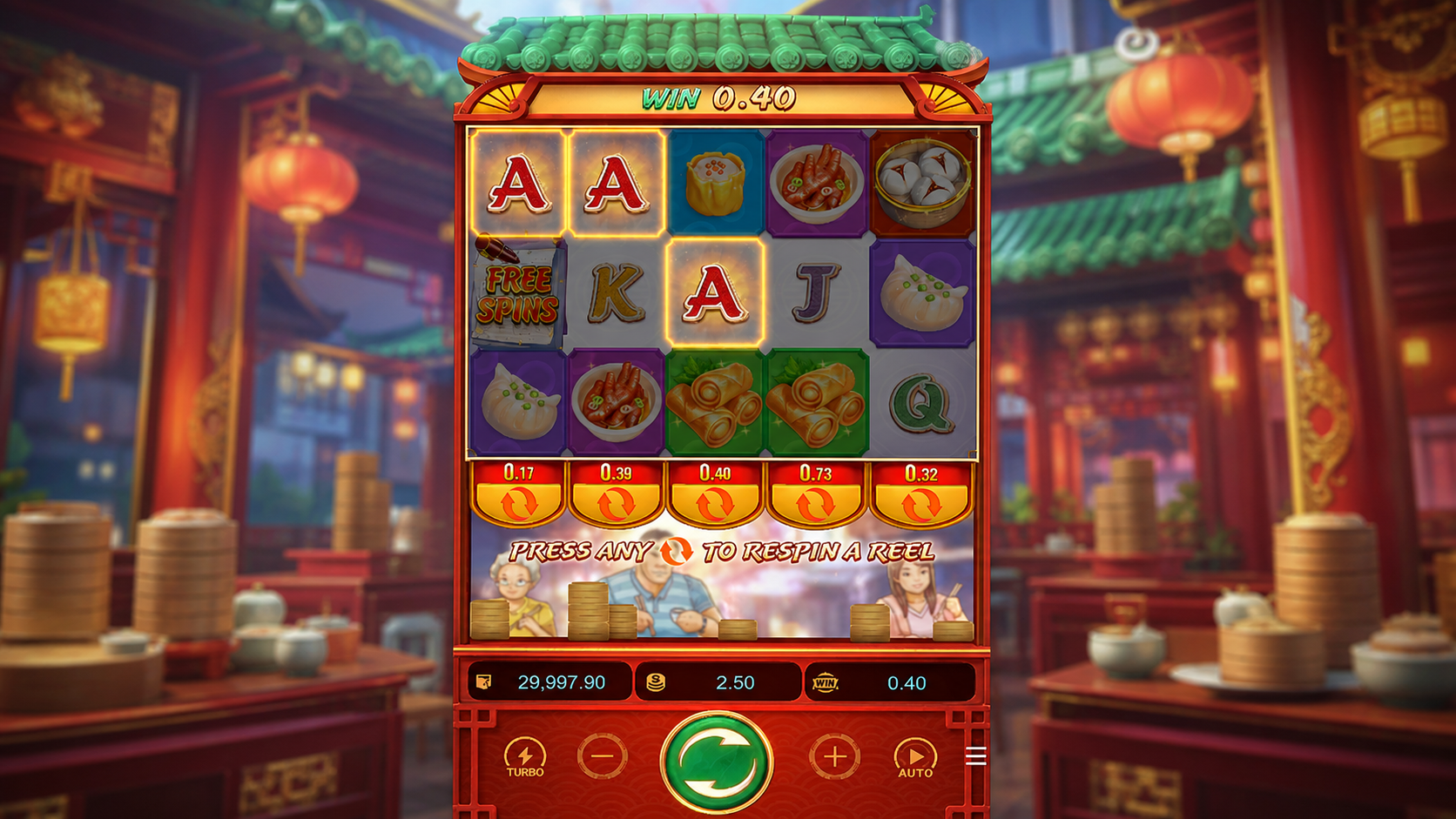
The five orange buttons are the main mechanic
After a main-game spin, the orange circular arrows below the reels become selectable. Each button shows the current cost for respinning its reel. Selecting one causes that column to move again while the remaining four columns stay fixed.
The feature can be used multiple times at additional cost. It remains a sequence of separate paid events rather than one complimentary retry. A second press creates a second charge. Repeating the action does not turn the next respin into a free one, and the visible price may change with the resulting screen.
Only new winning combinations formed by the respin are paid. This rule prevents an existing win from being collected again merely because an unrelated column moved. Suppose the first three reels already contain a paying dumpling route. Respinning reel five does not pay the untouched three-reel route a second time unless the new reel creates a new qualifying combination under the game rules.
That distinction is central to evaluating the feature. The grid may still show glowing symbols from the original result, but they are not an endlessly reusable prize. The respin must form a new route, extend a route or trigger the Free Spins condition.
The feature is limited to the main game. It disappears during Free Spins, where every win already receives the fixed x3 multiplier. The game therefore has two clearly separated modes: a base game with paid control over one reel, and a bonus with automatic spins plus a global multiplier.
Changing the bet amount also disables Reel Respin until the next normal spin ends. This keeps a position generated at one stake from being modified at another. The displayed reel costs and the frozen grid belong to the bet that created them.
Why a respin price is not a forecast
The unequal prices make it tempting to read hidden information into them. The rules directly reject that interpretation. A higher price does not signal a better chance, and a lower price does not signal a weak reel.
The game can calculate value from the current arrangement without changing the random reel-strip probabilities. A reel surrounded by many potential premium routes may be more expensive because replacing it has greater mathematical effect. That is different from saying the next stop is more likely to win.
The selected reel also has two possible jobs. It may need to supply a missing symbol, or it may need to preserve an existing set of symbols while improving another route. On a ways grid, a column holding three useful matches may be too valuable to disturb even if its displayed respin cost is low.
The game does not mark a recommended reel. All five arrows share the same visual weight, and the decision remains with the user. This is a better fit for the mechanic than a glowing suggestion because the screen may contain several competing goals.
A respin aimed at a five-reel premium combination differs from one aimed at Free Spins. The first needs specific natural symbols on the final reel. The second only needs another Scatter anywhere because Scatter awards do not follow the left-to-right ways rule.
Two Scatters already carry cash value
The order-pad symbol marked Free Spins is the Scatter. It pays anywhere on the grid, beginning with two copies. The paytable lists 25 units for two, 50 for three, 250 for four and 2,500 for five.
Three, four or five Scatter symbols all start the same 15-spin feature. Landing more than three increases the Scatter award, but it does not raise the initial number of spins beyond 15. This is an unusual split between trigger quantity and bonus length.
Two Scatters create an interesting base-game position because they already pay and sit one symbol short of the feature. A single-reel respin may then target a column without a Scatter while the two existing order pads remain frozen. The extra spin still carries a separate cost, and the third Scatter is not guaranteed.
Scatter combinations do not require reel one and do not need adjacent positions. An order pad on reel one, another on reel three and a third on reel five still triggers the feature. This makes the Scatter the only symbol family that ignores the ordinary ways geometry.
The high five-Scatter value also explains why a respin involving several fixed order pads may be priced differently from a reel surrounded by low card symbols. The cost may reflect the position, but it does not reveal what symbol the moving reel will stop on.
Free Spins removes the menu of reel prices
Landing at least three order pads starts 15 Free Spins. Every win during the feature is multiplied by x3. The factor applies across the bonus rather than rising from spin to spin.
There is no paid individual-reel respin in this mode. Each bonus spin resolves as a normal 243-way result, the x3 factor is applied to any win, and the next free spin begins. The removal of the orange price row makes the bonus mechanically simpler than the base game.
Free Spins may be retriggered by another valid Scatter combination. Since the ordinary trigger grants 15 spins, a retrigger creates another batch under the same x3 rule. The multiplier does not climb to x6 after retriggering; it remains x3 on each qualifying win.
The flat multiplier works particularly well with multi-way Wild wins. A teapot on one of the three middle reels may create several routes for the same food symbol. The game totals those ways according to the normal calculation and applies x3 to the resulting bonus win.
The bonus reconstruction above follows the real cabinet, established symbol set and in-game rule stating that all Free Spins wins receive x3. The paid reel buttons are absent because Reel Respin is unavailable during this mode.
The fixed 15-spin length creates a different pace from the base game. There is no decision after every stop, so several spins pass quickly. The x3 marker remains the main point of reference until another Scatter set appears or the counter reaches zero.
Medium volatility does not mean an even session
Dim Sum Mania is rated medium volatility. That classification describes the mathematical distribution relative to lower- and higher-variance designs; it does not turn wins into a steady schedule.
The 243-way grid produces many small symbol routes, while premium characters and multi-way combinations create larger spikes. Free Spins multiply every qualifying award by three. The paid respin layer adds another source of irregularity because two sessions with the same initial reel results may diverge if different extra spins are purchased.
The listed 96.75% RTP is a long-run model value, not a result expected from a short test. It also needs to be read with the feature rules in mind. A respin is another wager with its own displayed cost. Comparing a final cash win only with the original 2.50 spin ignores any extra charges made after the first stop.
For example, a 2.50 base spin followed by respins costing 0.40, 0.73 and 0.32 has used 3.95 in total. A resulting win of 3.00 looks larger than the original base stake but remains below the combined cost of the sequence. The interface shows each charge separately, so the full path needs to be reconstructed from those amounts.
This is not a flaw in the RTP figure. It is a consequence of a game that permits optional paid actions after the base result. Session outcomes depend on both reel randomness and the number of extra wagers added to visible positions.
A secondary Dim Sum Mania database lists a hit rate near 30.36%, but that figure is less useful here without a precise definition of how respin events are counted. The 96.75% RTP and medium-volatility classification are the more consistently published specifications.
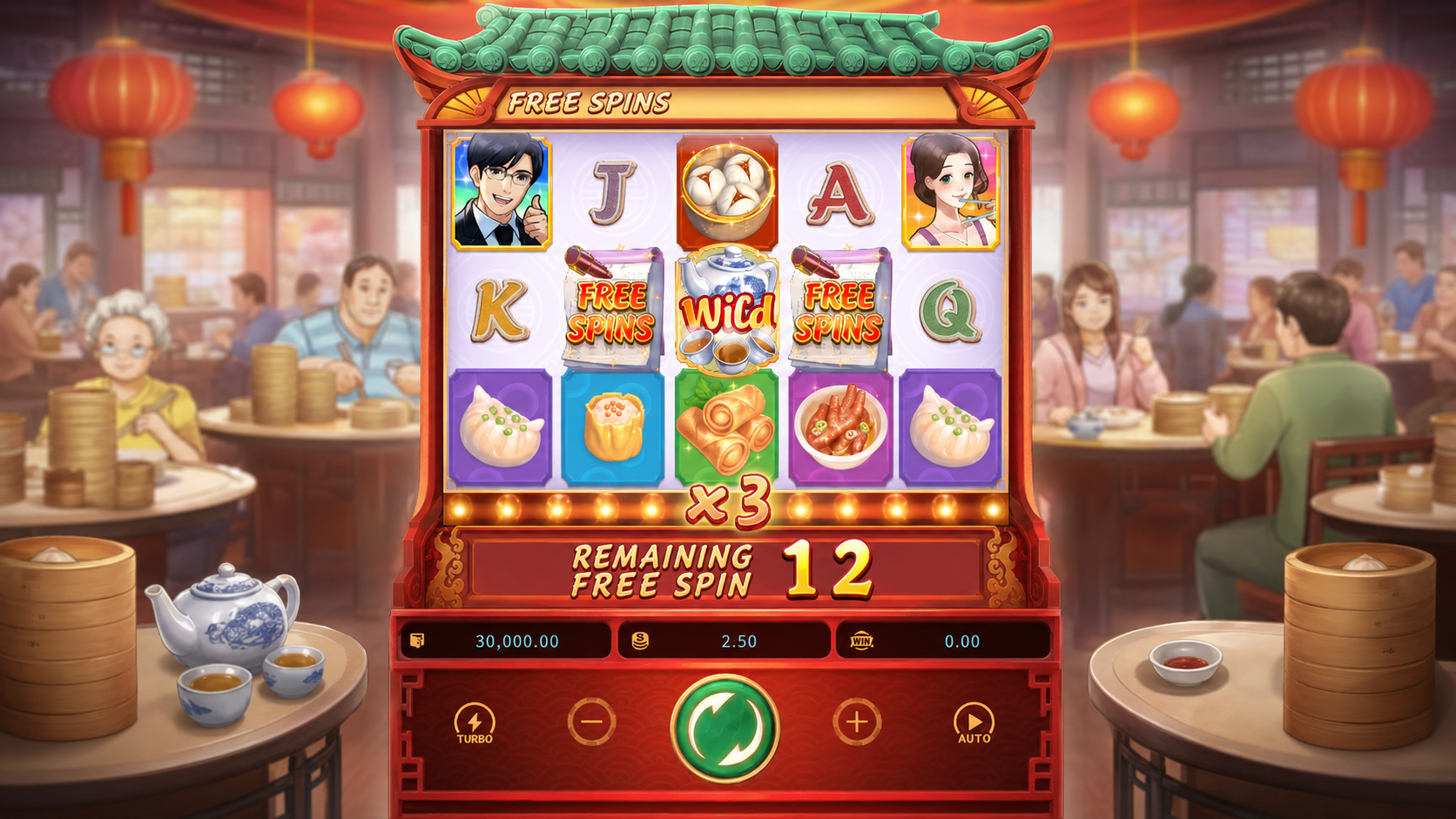
How the 20,000x ceiling relates to the paytable
The male diner pays 4,000 paytable units for five consecutive reels, yet the advertised maximum is 20,000x. Those numbers describe different layers of the calculation.
A symbol value is multiplied by bet size, bet level and the number of winning ways. Several copies on one or more reels can create multiple five-reel routes. Simultaneous wins for different symbols are added. Scatter value may also be present on the same screen, and bonus wins receive x3.
The 20,000x figure is therefore a game-level ceiling rather than the value printed beside one symbol. It should not be read as five copies of the male character automatically producing 20,000x. Position count, winning-way count, bet configuration and active mode all matter.
The paytable also shows why five premium symbols are difficult to compare from a static picture. One man on each reel creates one route. Three men on reel one, two on reel two and one on each remaining reel create six five-reel routes. Both screens display the same character across all five columns, but their way counts are different.
During Free Spins, the finished win receives x3. That factor raises the value of dense multi-way screens, though the advertised cap still limits the final award. The x3 does not change the symbol route count; it changes the payout after the normal ways calculation.
A 2020 mobile interface that still makes sense
Dim Sum Mania was built around a portrait cabinet. The green roof sits above the reels, the 5-by-3 grid occupies the centre, and the restaurant counter fills the strip below it. Balance, total bet and win appear above the main spin controls.
The respin prices fit naturally between the grid and counter. Each button is directly beneath the reel it controls, so there is no need to match a menu label with a distant column. This positional mapping is the strongest part of the interface.
The main spin button is large enough for one-handed phone use. Turbo, stake adjustment and autoplay sit around it without covering the paid respin row. A wide desktop monitor simply places scenery around the tall cabinet.
Text size is less consistent. The main balance and bet figures remain readable, but rule pages contain dense paragraphs designed for a long phone screen. The important respin warnings are easy to miss if the help page is only skimmed.
The soundtrack uses light percussion and restaurant ambience rather than a dramatic orchestral score. Wins add short celebratory cues, while the reel-respin buttons use a more immediate click-and-spin sound. Audio supports the timing of the second wager without making every small result feel oversized.
The restaurant theme is specific without becoming a story
The visual setting draws from a Cantonese dim sum restaurant, including bamboo steamers, tea service, green tiled roofing and red lacquer panels. The food icons match the cabinet instead of functioning as unrelated generic symbols.
The title art centres on a large steamed bun being opened with chopsticks. Siu mai and chopped spring onion surround it. The image communicates the subject before the title needs to be read.
There is no narrative progression. The diners do not unlock new scenes, the restaurant does not gain upgrades, and the menu does not change during Free Spins. Theme is used as a consistent frame for the mechanics rather than as a developing plot.
That restraint works because the respin buttons resemble placing another order. Each reel carries its own price, and the player chooses one item from the row. PG Soft did not turn that metaphor into a separate mini-game, but the connection between restaurant bill and reel cost is easy to feel.
Free Spins is visually plainer. The x3 factor and remaining-spin counter replace the pricing decision. The cabinet remains in the same restaurant, so the mode change is functional rather than theatrical.
What the design gets right
Dim Sum Mania attaches its main feature to a screen that already exists. Four reels are preserved, one reel changes, and the effect of the choice is immediately visible. No separate bonus board is needed.
The five prices are mapped clearly to their reels. A selected column does not need an explanation after it starts moving. The game also discloses that price does not equal chance, which prevents a common misunderstanding.
Paying only new combinations is a sensible rule. Without it, a small existing win could be collected repeatedly by moving an irrelevant reel. The restriction keeps the respin focused on creating or extending routes.
The Wild limitation is also well judged. Teapots on reels two, three and four strengthen the middle of a chain, but natural endpoint symbols remain necessary. The Wild helps the ways grid without making five-reel combinations trivial.
Free Spins simplifies the cabinet at the right moment. Fifteen automatic spins with a flat x3 factor create a clear contrast with the decision-heavy base mode. Retriggers extend the same structure instead of adding another rules layer.
Where the second order becomes expensive
Repeated respins can obscure the true cost of one resolved position. The game displays every charge, yet the final win field does not automatically frame the result as original stake plus all optional respins. A sequence may feel successful because it ends with a win even when the combined charges are larger.
The unequal prices may also suggest information they do not contain. The help page warns against this, but that warning is separated from the main reels. Someone who never opens the rules may assume the most expensive reel has stronger odds.
Only new wins are paid, which is mathematically necessary but not visually obvious. Existing symbols remain on screen after a respin, and a glowing route may look as though it has paid again. The distinction is easier to understand from the rule page than from the animation alone.
The base mode can also become slow if every screen is examined as a puzzle. That is the cost of giving the user a post-spin decision. Free Spins removes the pause, but the regular game is less automatic than most 243-way slots.
The theme has charm without much development. Food icons, staff and restaurant decor remain static across a long session. The mechanic carries more personality than the characters do.
Who will understand Dim Sum Mania fastest
The game makes the most sense to someone comfortable reading a 243-way grid from left to right. Recognising how matching-position counts multiply across reels makes the single-reel decision easier to interpret.
It also suits analysis based on visible positions. The initial screen is known before an optional wager is made, and four reels stay frozen. That is different from a blind bonus purchase or an Ante Bet activated before the result exists.
Anyone expecting the respin price to function as an odds quote will misunderstand the feature. The amount is a charge attached to changing one reel, not a prediction printed by the game.
Free Spins requires less interpretation. Three Scatters start 15 spins, all bonus wins receive x3, the feature may retrigger, and paid reel respins are disabled. The bonus is straightforward once the Scatter and Wild restrictions are known.
Final serving
Dim Sum Mania remains interesting because the main feature begins after the normal slot would have finished. The first wager creates a position. Five separate prices then turn that position into a small decision board.
The strongest rule is also the easiest to overlook: only new combinations created by a respin are paid. The second most important rule is that reel price does not indicate win probability. Together, those statements define how the mechanic should be read.
The rest of the design is compact. There are 243 left-to-right ways, a teapot Wild restricted to reels two through four, an anywhere-paying Scatter, 15 retriggerable Free Spins and a flat x3 bonus multiplier. Medium volatility and a 96.75% listed RTP sit beneath an advertised 20,000x ceiling.
PG Soft could have made the restaurant busier with more side systems, but the restrained format keeps attention on the orange buttons below the reels. Dim Sum Mania is not really about ordering as many dishes as possible. It is about deciding if one more reel belongs on the bill.
By Fairy Editorial - 27 Jul 2026

Super Wildrix
Super Wildrix Review: The x100 Wheel Is Powerless Until the Hero Lands
Super Wildrix looks like a superhero slot, yet the cape and casino-city setting are mostly framing. The actual identity sits inside a single symbol: a masked hero who expands over an entire reel and carries an x2 multiplier. That character may appear in the regular game, and the same mechanic becomes far more dangerous in Free Spins when a wheel can raise the multiplier as high as x100.
The important catch is easy to miss. A large wheel result does not create a payout by itself. It needs a Wildrix symbol, and the expanded Wildrix still needs a valid payline win to multiply. This dependency gives the game a sharper rhythm than its loud comic-book presentation suggests. Long patches may pass with ordinary fruit and card symbols, then a hero reel changes several paylines at once.
Released by Pocket Games Soft, usually shortened to PG Soft, Super Wildrix uses a 5-reel, 5-row grid with 25 fixed paylines. The declared RTP is 96.75%, volatility is rated high, and the maximum win is 20,000 times the stake. The official information sheet also lists a 22.03% total hit rate. Those figures describe a slot built around concentrated events rather than a constant stream of meaningful returns. The full specifications are published in the PG Soft game information sheet, while the publisher page identifies the title as game 195 in its catalogue on the official PG Soft website.
A familiar grid with one disruptive symbol
The 5-by-5 arrangement is larger than the old three-row format, but Super Wildrix does not use cluster pays or all-ways evaluation. It keeps 25 fixed lines. A paying combination starts on reel one and runs through adjacent reels from left to right. Three or more matching symbols are normally required, so symbols sitting in the middle or at the far right do nothing unless a valid chain reaches them from the first reel.
This matters because the tall grid can look busier than the pay system really is. Five rows put 25 symbol positions on screen, yet only the marked paths count. A line may zigzag between rows, and the on-screen payline display is more useful here than in a ways slot. The larger grid increases the number of places where the hero may land, but it does not turn every neighbouring match into a prize.
The symbol set mixes casino fruit with superhero decoration. Cherries, grapes, bells, horseshoes and red 77 symbols occupy the reels beside card ranks. A gold badge acts as the Scatter. The ordinary W symbol is the standard Wild, while the full-height hero is the Wildrix. The fruit cabinet is a strange fit for Neonshine City, though it keeps the values readable on a small phone display. PG Soft chose recognition speed over a fully developed comic-book world.
That decision also makes the reels easy to scan. Cherries and grapes are distinct at a glance, the gold Scatter does not blend into the background, and the hero reel is impossible to mistake for a normal symbol. The slot rarely leaves the player wondering which special symbol just landed. Its weakness is thematic depth rather than visual clarity.
Wild and Wildrix are not the same thing
Both Wild types replace every paying symbol except the Scatter, but only Wildrix expands and brings a multiplier. A normal W can finish a line without changing its value. Wildrix fills its entire reel, substitutes across every row and attaches x2 to all wins connected to it.
The expansion occurs after the reels stop. A single hero symbol becomes a full stack, which means the original landing position does not limit its usefulness. If Wildrix lands near the bottom of reel three, the completed hero still occupies all five cells on that reel. Any of the 25 paylines crossing reel three may then use it as a substitute.
Multiple Wildrix reels do not multiply one another in the base game. Their x2 values are added. The official wording states that all wins are multiplied by the total sum of multipliers from the expanded Wildrix symbols. The practical math is:
One expanded Wildrix produces x2.
Two expanded Wildrix symbols produce x4, not x8.
Three expanded Wildrix symbols produce x6, not x12 or x16.
That additive rule keeps the regular game from escalating too rapidly. Two full hero reels can connect many paylines and turn four- or five-symbol matches into much larger results, but the multiplier grows in steady x2 steps. Reviews that describe the base multipliers as multiplying together overstate the mechanic.
The screen above shows the most useful kind of base-game event. Two hero symbols have expanded on adjacent reels, and the game displays x4. That label confirms the additive calculation. More importantly, the heroes occupy ten symbol positions between them. Their value comes from the combination of full-reel substitution and the multiplier, not from x4 alone.
A Wildrix on reel one is especially efficient because every standard line begins there. A hero on reel five still helps complete four- and five-reel combinations, but it cannot rescue a line already broken on an earlier reel. Location therefore matters even though every Wildrix carries the same printed x2.
The ordinary Wild has a quieter role. It can bridge a missing symbol and preserve a line, but it neither expands nor participates in the Wildrix multiplier total. This distinction is worth checking in the paytable before playing because both symbols use the same angular W branding. The hero portrait and full-reel animation are the clearest signs that the stronger version has landed.
What the base game actually feels like
Super Wildrix runs at high volatility and places much of its theoretical return inside Free Spins. The published component figures assign 58.90% RTP to the main game and 37.87% to the Free Spins section. Those components are rounded separately, so their displayed sum differs slightly from the declared total RTP of 96.75%. The same rounding effect appears in the hit-rate components.
The regular game hit rate is listed at 21.44%. In plain terms, a line result appears on a little more than one spin in five over the mathematical model, but that number says nothing about profit. A small cherry match counts as a hit just as a multi-line Wildrix result does. The figure should not be read as a one-in-five chance of finishing ahead.
Ordinary results are often modest because fixed paylines narrow the routes that count. The tall reel set can show several matching symbols without forming a left-to-right line. That creates visual near-misses that would pay in a cluster or ways game but remain blank here. The payline structure is not unfair; it is simply less permissive than the 25-cell display first implies.
Wildrix landings change the texture immediately. Expansion makes every row on that reel usable, so several paylines may score together. The x2 total then applies after the individual line awards are added. When two heroes land, the x4 label appears across the reels and the result becomes much easier to follow than a stack of separate multiplier notices.
The base game is at its best when Wildrix arrives on reels one through three. Those positions can start or preserve many combinations. A late-reel hero needs useful matching symbols already aligned to its left. This is the central source of tension in regular play: the hero is powerful, but it is not position-proof.
There is no cascade after a win, no collection meter to fill and no persistent multiplier carried from one paid spin to the next. Each result resolves cleanly, then the grid resets. That keeps the pace brisk, though it also means a weak spin has no residual value. Super Wildrix asks the player to wait for a self-contained event rather than build progress across a session.
The wheel is an amplifier, not a prize
Three, four or five Scatter symbols award 10, 15 or 20 Free Spins. The bonus changes the top of the cabinet by adding a multiplier wheel. At the start of every free spin, the wheel selects a value from x2 up to x100. The selected figure then modifies any Wildrix multiplier appearing on that spin.
The order of operations is essential:
- The wheel selects a multiplier.
- Any Wildrix symbol landing on that free spin expands over its reel.
- The base x2 printed on each expanded Wildrix is multiplied by the wheel result.
- If more than one Wildrix expands, the adjusted values are added.
- The resulting total multiplies the qualifying payline wins.
Suppose the wheel stops at x10 and one Wildrix lands. The hero value becomes x20 because x2 multiplied by x10 equals x20. If two Wildrix symbols land on that same spin, each becomes x20 and the two values add to x40. The slot does not calculate x20 times x20.
At the top wheel result, x100 paired with one hero creates x200. Two heroes under the same wheel result become x200 each and combine as x400. The potential is substantial, yet three conditions still need to align: a strong wheel number, at least one Wildrix, and a valid line win. A wheel stopping at x100 without Wildrix has no multiplier to modify. A Wildrix landing without useful symbols to its left may also produce much less than the animation implies.
This design avoids giving the wheel independent cash values. It is not a prize wheel in the usual sense. It is a coefficient generator attached to another random event. A player evaluating a free spin should therefore look at the hero reels before reacting to the number above them.
Ten spins may contain very different amounts of real action
The Free Spins entry hit rate is listed at 0.58% in the official sheet. This is a model figure rather than a promise of a fixed interval. A short session may reach the bonus quickly, while a much longer one may not trigger it at all.
Once inside, every spin gets a wheel result, but not every spin gets Wildrix. That separation produces two layers of suspense. First comes the wheel; then the reels decide if its number matters. A low wheel result can still attach to several hero reels and score well. A high number can pass unused if the hero stays away.
Two Scatters during Free Spins add three more spins. Requiring only two is less demanding than the original three-Scatter entry condition, and repeated extensions are possible. Extra spins have more value here than a simple fixed-spin addition suggests because each one creates another independent wheel-and-Wildrix attempt. They do not raise a persistent meter or retain the previous wheel value; every added spin starts its own calculation.
The free-spin image shows the mechanic in a readable state. The wheel has selected x10, while the hero reel displays x20. That is the printed x2 Wildrix multiplied by the current wheel value. The win lines then cross through the expanded reel. The screen demonstrates why the wheel cannot be judged separately from the grid below it.
The bonus also explains the high-volatility label better than the base game does. Most wheel values and reel stops will not form the rare combination needed for an exceptional result. When several elements align, the multiplier can leap far beyond the steady x2, x4 and x6 progression of ordinary spins. The 20,000x ceiling exists to cap those extreme combinations.
Reaching the 20,000x maximum ends the active spin according to the game rules. That figure is maximum exposure, not a typical target. It describes the upper boundary of the model and should not be confused with an expected bonus return.
Reading the 96.75% RTP without dressing it up
The listed RTP is 96.75%. It is a long-run mathematical average calculated across the full game, including the bonus and rare high multipliers. It does not forecast what will happen in a personal session, and a particular operator configuration or market version should always be checked in the live information panel.
The component breakdown is more informative than the headline number. Main-game RTP is shown as 58.90%, while Free Spins account for 37.87%. Separately rounded component values do not match the declared total figure to the last hundredth. That tiny discrepancy is normal in a specification sheet that rounds several calculations.
The split indicates that a large share of theoretical return is tied to a bonus reached on only a small fraction of spins. This concentration supports the high-volatility classification. It also explains why judging the slot from a handful of base spins is unreliable. The model includes infrequent wheel events capable of carrying much more value than an ordinary line hit.
Total hit rate is 22.03%, with 21.44% assigned to the main game and 0.58% to Free Spins entry. Those displayed components again differ from the total by one hundredth after rounding. Hit rate counts winning occurrences, not their size. A 22.03% figure can coexist with long losing runs, clusters of tiny hits and rare large outcomes.
The default specification lists a stake range from €0.25 to €100. Peso-facing casinos may convert or configure that range differently, so the figure on the local bet panel is the one that applies. The mathematical limits do not imply that every Philippine-facing operator will display the same minimum, maximum or feature price.
Ante Bet changes more than the button colour
An Ante Bet option raises the stake to ten times the selected base amount and guarantees at least one Wildrix on every paid spin. Industry coverage of the launch also states that the guarantee carries into Free Spins. The mechanic is described in the PG Soft launch report from EE Gaming and the release summary from iGamingExpress.
Ten times the stake is not a small fee attached to the same spin. It creates a materially different cost structure. At a displayed base bet of 1, the Ante version costs 10. The guaranteed hero makes every reel stop more active because a full-reel substitute and at least x2 are already present, but the result must be compared with the tenfold amount risked.
The guarantee also changes the Free Spins wheel. In the normal mode, the wheel may produce a large number that never connects with Wildrix. Under Ante Bet, at least one hero is present, so every bonus spin has a multiplier target. That removes one layer of dependency, though it does not guarantee a profitable line. The hero still needs symbols arranged into one of the 25 paths.
It would be misleading to call Ante Bet a simple improvement. It buys certainty around the signature symbol at a steep price. The relevant comparison is return relative to the enlarged stake, not the raw number flashing after a win. A payout that looks larger may represent a smaller multiple of the amount actually committed.
Feature Buy shortens the wait, not the mathematics
Where enabled, Feature Buy opens a menu that sells direct access to Free Spins at the price displayed in the game. PG Soft does not state a single universal purchase cost in the general information sheet, so a fixed number should not be copied from another casino. Jurisdiction, operator settings and currency presentation may change availability or pricing.
Buying the bonus skips the base-game route to three or more Scatters. It does not remove the two-part dependence inside Free Spins. The wheel still needs Wildrix, the hero still needs a valid line, and the 20,000x cap still applies. A purchased round may finish with modest value despite showing several large wheel numbers.
This mode is best understood as a route selector. It concentrates the session around the mechanic responsible for 37.87% of the published RTP, but it also compresses the cost into one decision. The bonus itself does not become more generous merely because it was purchased.
Neonshine City looks better in motion than in the symbol list
The setting is called Neonshine City, with a masked casino hero charging into the Crystal Casino. Pink, blue and gold lighting place the action somewhere between a comic-book arcade and a late-night gaming floor. The presentation is loud, but the central reel area remains legible.
Wildrix carries most of the personality. His portrait stretches vertically when he expands, electric light traces the reel edges and the multiplier appears across the centre. The animation makes a mechanical fact clear: this is a full-reel substitute, not a large portrait sitting in one cell.
The Free Spins cabinet is more successful than the base screen. The wheel occupies the space above the reels without shrinking the symbols beyond recognition. Its result remains visible while the hero expands, making the x2-by-wheel calculation easy to verify. The remaining-spin counter sits below the grid and does not cover the payline display.
The soundtrack and win effects lean into arcade heroics, with sharp electrical cues around Wildrix and heavier fanfare for larger totals. They are tightly timed rather than drawn out. Regular losses clear quickly, which suits a game that may need many attempts before its central combination appears.
The generic fruit symbols are the visual compromise. They make the game instantly readable, but they do little to develop the superhero premise. A deeper comic cast, villains or city-specific objects could have made the world more memorable. As it stands, the theme is concentrated in the hero, the logo and the bonus cabinet.
Built for a phone held upright
PG Soft lists an optimal 1080-by-2340 display with a 19.5:9 ratio. That specification explains the tall cabinet and the generous vertical spacing around the reels. The interface was designed for portrait mobile play first, not squeezed down from a desktop landscape layout.
On a phone, the spin button and stake controls sit within easy thumb reach below the grid. Balance, current bet and win total remain separated. The information menu houses the paytable, rules, RTP and control explanations, so the main screen avoids permanent text blocks.
Landscape desktop displays place blurred casino scenery around the narrow cabinet. The side space is decorative; it does not contain extra reels. This can make the game look smaller on a wide monitor, but it preserves the portrait proportions and keeps every control in the intended position.
Philippine mobile users should find the layout familiar because PG Soft has used a similar portrait-first shell across much of its catalogue. Performance still depends on the casino client and connection, but the visual hierarchy is sensible for one-handed use. The wheel, hero multiplier and remaining-spin count are readable without opening a secondary panel.
Where Super Wildrix gets the math right
The strongest part of Super Wildrix is the relationship between symbol coverage and multiplier value. An expanding Wild is already useful on a 5-row grid. Attaching x2 makes the event matter without turning every base-game appearance into an absurd number. Adding multiple heroes rather than compounding them preserves clarity.
Free Spins then change the scale without rewriting the rule. The wheel multiplies each hero value, and multiple adjusted hero values are still added. The same logic governs both modes, so the bonus feels like a powered-up version of the base game rather than an unrelated side activity.
The rules are also inspectable on screen. Two base-game heroes display x4. An x10 wheel beside one hero displays x20. A player does not need to infer a hidden formula from the final cash amount. This transparency is valuable in a slot with several multiplication stages.
Retriggers fit the structure well. Two Scatters add three spins, creating more wheel attempts without introducing a second bonus mode. The slot remains focused on its central mechanic from the opening spin to the maximum-win scenario.
Where the cape starts to drag
The same focus can become repetitive. Outside Wildrix and Free Spins, little changes. There are no cascading symbols, persistent upgrades, roaming reels or collection goals. Base spins without the hero resemble a conventional 25-line fruit slot dressed in neon.
The wheel presentation may also exaggerate weak spins. Seeing x50 or x100 creates an immediate expectation, but the number is inert without Wildrix. Even when the hero lands, a broken left-to-right path can leave the result far below the visual promise. That is mathematically coherent, though it can feel anticlimactic.
High volatility and a bonus-heavy RTP split make short tests especially noisy. A demo run with no Free Spins misses a large part of the model. A lucky bonus with an early x100 hero may create the opposite impression. Neither sample reveals the long-run distribution.
The superhero story never moves beyond its opening premise. Wildrix does not fight an enemy, rescue a character or change form as the session develops. Anyone drawn by the comic-book artwork may find a mechanically clear slot rather than a narrative one.
Ante Bet raises another point of caution in interpretation. A guaranteed Wildrix sounds decisive, yet the cost is ten times the base stake. Raw wins become visually larger, which makes comparisons across modes difficult unless everything is converted back to stake multiples.
Final assessment
Super Wildrix is a compact multiplier slot with a correctly defined hierarchy. Fixed paylines determine the win, full-reel heroes improve coverage, hero values add together, and the Free Spins wheel scales each hero before that addition. Once those steps are understood, the game becomes much less mysterious.
Its best moments come from overlap: two expanded heroes supporting several paylines in the base game, or a high wheel result attaching to a hero during Free Spins. The wheel alone is only decoration with a number on it. Wildrix alone is useful but controlled. The combination is where the 20,000x ceiling becomes relevant.
The published 96.75% RTP is respectable on paper, while the 58.90% main-game component and 37.87% Free Spins component reveal how much weight sits behind the bonus door. A 22.03% hit rate does not soften the high-volatility profile because many counted hits are small and the rare multiplier chains carry disproportionate value.
PG Soft has kept the rule set narrow and readable. That restraint helps the math, yet it leaves the base game exposed when the hero is absent. Super Wildrix works best for someone interested in one strong mechanic studied across two modes, not for someone expecting a long list of side systems.
The final verdict is straightforward: the x100 wheel is not the star by itself. The star is the expanded Wildrix reel, and the wheel only decides how much power that hero receives. That dependency gives the slot its tension, its dry spells and its largest possible swings.
By Fairy Editorial - 27 Jul 2026

Zombie Blasters
Zombie Blasters Review: One Alarm Can Turn a Pixel Horde Into a Multiplier Ambush
Zombie Blasters puts an arcade cabinet in the middle of a ruined street and treats every spin like another coin dropped into the machine. A block-headed zombie charges from the left. A heavily armed survivor fills the opposite side of the screen. Between them sits a narrow reel cabinet with a red button, an alarm lamp, and a multiplier wheel mounted above the grid.
The shooter theme is mostly presentation. There is no aiming system, health bar, ammunition counter, or character upgrade tree. The real fight takes place inside a 30-cell Scatter Pays board where groups explode, replacement symbols fall, and multipliers wait for a winning result before becoming valuable.
That distinction helps explain the game quickly. Zombie Blasters is not a shooter converted into a slot. It is a high-volatility multiplier slot dressed like a late-night arcade machine. The gunfire, alarm lights, and voxel zombies give the math a personality, but the session is decided by cluster size, cascade length, multiplier timing, and the number of spins left after the bonus meter starts growing.
PG Soft released the title in June 2026. The studio describes it as a 5 by 6 symbol slot, while the visible screen is most naturally read as six columns across and five rows down. Either description points to the same 30 positions. The official PG Soft game information sheet confirms a 96.75% RTP, high session volatility, a 24.81% hit rate, collapsing reels, and a maximum result of 10,000 times the stake.
Cabinet specifications
Developer: Pocket Games Soft, commonly shown as PG Soft
Release period: June 2026
Grid: 30 positions in a 5 by 6 arrangement
Pay method: Scatter Pays
Minimum matching-symbol count: 8
Reel action: winning symbols disappear and replacement symbols fall
Published RTP: 96.75%
Published hit rate: 24.81%
Session volatility: High
Maximum win: 10,000 times the bet
Standard multipliers: x2 symbols
Wheel range: x5 to x50
Free Spins entry: 4, 5, or 6 or more Scatter symbols
Default stake range in the official sheet: €0.20 to €100
Feature Buy: direct Free Spins entry at the locally displayed price
The numbers point to a slot that does not need constant visual complexity. Its payout model depends on a few mechanisms interacting at the right time. An ordinary cluster starts a reaction. The reaction may expose another cluster. Multiplier symbols then affect the combined result. An Alarm can replace every active multiplier with a much larger wheel value. Free Spins retain multiplier value for later rounds.
The difference between an unremarkable spin and a major result is therefore not always visible on the first grid. Much of the value may arrive after the first winning group disappears.
Thirty cells with no paylines to trace
Zombie Blasters ignores traditional left-to-right paylines. Eight or more matching symbols anywhere on the board create a payout. The symbols do not need to begin on the first reel, and the game is not asking the eye to follow diagonal lines through the cabinet.
This makes the opening read of a spin unusually direct. Count repeated symbols across all 30 positions. A group of seven misses. A group of eight pays. Larger groups reach higher paytable tiers.
The system is sometimes called Cluster Pays on casino pages, but Scatter Pays is the more precise description here. A cluster system normally requires matching symbols to touch horizontally or vertically. Zombie Blasters counts identical symbols anywhere on the grid. Two matching icons on opposite corners still contribute to the same total.
That rule changes how crowded boards should be interpreted. A screen filled with the heroine symbol may pay even when the characters are separated by letters, knives, and pistols. Position matters less than quantity until special symbols enter the calculation.
The lower-value set uses 10, J, Q, K, and A. The premium side consists of a knife, pistol, zombie, and the red-haired heroine. Their chunky outlines are more than a stylistic choice. PG Soft built the title around a portrait-oriented cabinet, so every symbol needs to remain readable when the playable grid occupies only the middle portion of a wide display.
The heroine and zombie are especially easy to count because their faces create strong blocks of red, green, and skin tone. Weapons are slimmer and can disappear visually among letter symbols during a fast drop. Slowing down is not required for the rules, but the contrast difference explains why character-heavy boards feel more immediately promising.
A winning board is only the first frame
Once eight or more matching symbols pay, those symbols are removed. Everything above the empty spaces falls, new symbols enter from the top, and the game checks the board again. Another qualifying group starts another reaction within the same paid spin.
The chain ends only when the replacement board contains no new win. All wins produced during the reaction belong to the same spin cycle, which becomes important when multipliers are applied.
The third image in this review shows the aftermath of a successful reaction. Most of the grid has been cleared, only a few symbols remain, and the win counter displays 52.50. A normal reel slot would have settled as soon as the first symbols stopped. Here, the empty spaces are evidence that the original outcome developed into something larger.
Cascades create two separate paths to a stronger spin. The first is simple accumulation: several small wins add together. The second is board renewal: removing a large number of symbols makes room for a fresh set, including multiplier or Alarm symbols that were not present at the start.
Long reactions are not automatically profitable. A chain can consist of low-value letter groups and finish without a multiplier. At the same time, a modest cluster can become the opening needed for an Alarm and several multiplier symbols to share the final board. The number of cascades matters, but the symbols remaining when the reaction settles matter more.
The game does a good job of keeping this sequence readable. Winning icons flash, vanish in square bursts, and leave a clean blue field behind. Replacement pieces drop in straight columns. The animation is quick enough to preserve the arcade rhythm without hiding which group caused the next step.
The x2 tiles are dormant until the spin pays
Standard multiplier symbols carry x2. They are not regular paying symbols, so a screen full of multipliers without a qualifying symbol group does not create a win by itself.
When the spin has a payout, visible multiplier values are added. One x2 tile turns the result into x2. Two x2 tiles create x4 rather than x2 multiplied by x2. Three create x6. The arithmetic is additive before it is applied to the accumulated spin win.
This distinction prevents a common misreading. Three x2 symbols do not make x8. Their printed values are combined into six, then that combined figure multiplies the relevant total.
The position of a multiplier is less important than its survival on the board at settlement. It does not have to sit inside the paying symbol group. That makes cascades useful even when the replacement symbols fail to create a huge cluster. A reaction may clear space, leave several x2 tiles visible, and build a respectable multiplier around an otherwise ordinary payout.
The weakness of the base system is equally clear. Multipliers can appear on dead spins. Seeing two x2 tiles on a board that does not contain eight matching symbols creates no consolation return. The game regularly shows the ingredients of a stronger result without supplying the qualifying win needed to activate them.
That near-miss language fits the high-volatility model. The board can look loaded while paying nothing, then a later spin uses fewer symbols far more effectively because one cluster keeps the calculation alive.
The red Alarm is where the math changes gear
The Alarm symbol connects the grid to the wheel above it. During a winning spin, an active Alarm triggers the Multiplier Wheel. The wheel selects a value from x5 to x50.
The selected number does more than add a single multiplier. The Alarm and every multiplier symbol currently present on the reels transform into the wheel value. Their values are then combined before multiplying the spin win.
Consider a board containing one Alarm and two ordinary x2 tiles. If the wheel stops at x20, all three become x20. Their combined value is x60. The strength of the wheel therefore depends on both the selected segment and the number of symbols being upgraded.
This is the central calculation in Zombie Blasters. A high wheel result attached to one symbol can be useful. A medium wheel result copied across several symbols can be much stronger. Counting the multiplier positions before the wheel stops gives a better sense of the possible outcome than staring only at the pointer.
The official material sets the wheel range at x5 to x50. The upper end is not required for a serious payout. If four symbols are changed to x15, the combined result is already x60. The game gains much of its top-end force through duplication rather than a single enormous printed multiplier.
Alarm timing also matters. It must coexist with a winning spin. An Alarm arriving after a cascade has failed to create eight matching symbols cannot rescue the board. In contrast, an ordinary low-tier cluster can become valuable because it gives the Alarm a valid event on which to act.
The relationship between cluster and Alarm is more interesting than the shooter artwork suggests. The cluster is the ignition. The wheel chooses the replacement value. The number of Alarm and multiplier tiles controls how widely that value is copied. The final spin win supplies the amount being multiplied. Four separate pieces must align.
Free Spins remember what the base game forgets
Four Scatters award 10 free spins. Five award 15. Six or more award 20. The trigger image above shows several heroine symbols, two Scatter chests, three x2 tiles, and an Alarm sharing the same board, illustrating how busy the transition can become before the bonus begins.
The main change inside Free Spins is memory. Multipliers collected during the round move into a pot beneath the reels and remain there until the bonus ends. New values raise the stored total instead of disappearing after one spin.
That turns the bonus into a progression system. Early spins establish the multiplier bank. Later spins apply a larger retained value. A multiplier collected on spin one has more future opportunities to matter than the same multiplier collected on the last spin.
The running pot works alongside multipliers visible on the current grid. At settlement, the game takes the stored value and the active reel multipliers into account before paying the free-spin win. An Alarm can sharply increase the current contribution because it replaces active multiplier symbols with the wheel result.
This produces several distinct bonus shapes.
A quiet round may collect little during the first half and leave the pot too small to transform ordinary clusters. Another may find several x2 symbols early, allowing even medium-sized groups to pay more heavily later. The strongest route adds an Alarm after multiple multiplier positions have appeared, pushing the current result and the stored progression upward while enough spins remain to use it.
Three or more additional Scatters during Free Spins add five spins. The stored multiplier remains in place. Retriggers are therefore more valuable late in a developed bonus than they would be in a mode where every spin resets.
Five extra rounds at a weak stored value mainly increase the number of attempts. Five extra rounds after the pot has grown give that accumulated value five more chances to meet a paying group. The retrigger does not merely extend the timer; it extends the useful life of everything already collected.
The bonus is still capable of finishing with a disappointing return. Persistent multipliers cannot create wins on their own. A large stored number needs clusters, and those clusters need at least eight matching symbols. The pot can look impressive while the board repeatedly lands groups of six or seven.
This tension keeps the bonus from becoming an automatic payout escalator. Progress is visible, but visible progress does not guarantee that the final spins will use it.
The 96.75% RTP is split more sharply than the headline suggests
The official information sheet breaks the 96.75% theoretical return into 65.09% assigned to the main game and 31.66% assigned to the Free Spins feature. Those components add to the published total.
This split says more about the design than a generic statement about RTP. Roughly one-third of the theoretical value sits in the bonus portion. The base game still carries most of the return, but a substantial share depends on entering and resolving Free Spins.
The published hit rate is 24.81%. The same sheet lists 24.38% for the main game and 0.44% for the Free Spins feature line. The small rounding difference is normal in summary data. The 0.44% figure should not be read as the chance that an individual free spin wins. It belongs to the feature component of the game-level hit-rate breakdown.
A hit rate near one result in four sounds active until win size is considered. A low-tier eight-symbol group counts as a hit. It may return less than the stake, especially without a multiplier. The statistic measures paid events, not profitable rounds.
High volatility describes the distribution more honestly. Value can gather around long cascades, copied wheel multipliers, and a Free Spins pot built early enough to work across several rounds. Ordinary hits keep the cabinet moving, while the rarer alignments decide the larger swings.
The 10,000x ceiling is enforced in both the main game and Free Spins. If a running result reaches the cap, the spin ends and the maximum amount is awarded. Further cascades or multiplier development are no longer needed once that point is reached.
This cap suits the multiplier structure. A wheel value can be copied across multiple positions, and the stored bonus pot may already be large. Without a firm stop, a rare board could compound beyond the intended exposure very quickly.
Feature Buy removes the wait, not the variance
The Feature Buy button opens a purchase menu where Free Spins may be started at the displayed price. PG Soft does not state a universal cost multiplier in the public information sheet, so a fixed figure should not be copied across casinos. Currency, operator configuration, certification, and local rules may affect what appears.
Buying the feature skips the natural Scatter trigger. It does not select an Alarm result, preload the multiplier pot, guarantee a retrigger, or change the need for eight matching symbols.
That makes the purchase a change in access rather than a change in the bonus rules. The same weak and strong bonus shapes remain possible. A round may build its pot early, late, or barely at all.
Some markets disable feature purchases. An absent button usually reflects jurisdiction or casino settings. It does not mean the base game is missing part of its normal cascade or multiplier logic.
The mobile-first cabinet looks strange on a desktop for a reason
PG Soft lists 1080 by 2340 at a 19.5 to 9 aspect ratio as the optimal display target. That is a tall phone screen. The desktop presentation keeps the narrow cabinet in the middle and fills the unused sides with the zombie and survivor artwork.
This layout has practical benefits. The six-column board remains large enough to read on a phone. The wheel sits directly above it. The win panel, balance, stake, and oversized red spin button form a vertical sequence beneath it. A thumb can reach the main control without covering the symbol area.
On a wide monitor, the central machine may look cramped compared with a slot designed natively for landscape play. The side characters occupy more area than the playable grid. That is not an accidental crop; it is the consequence of placing a portrait mobile interface inside a widescreen frame.
The arcade style handles this compromise better than many mobile-first slots. The narrow playable area resembles a physical cabinet, so the unused width reads as part of the room around the machine. The large zombie on the left and armed survivor on the right create a visual standoff across the central reels.
Pixel and voxel styling also reduces the horror tone. The undead look like toy blocks, weapons resemble arcade pickups, and explosions break into squares rather than blood. The game is about an apocalypse, but it behaves more like a bright cabinet shooter than a grim survival story.
The sound design follows the same direction. Synth pulses mark the reel drop. Clipped electronic bursts accompany disappearing symbols. The Alarm introduces a sharper siren before the wheel spins. Larger results use arcade score-counting sounds rather than orchestral fanfare.
There is enough audio information to separate the stages of a reaction. A player can hear the initial hit, the collapse, a new group, the Alarm, and the final multiplier calculation as different events. Repeated sessions may make the short loops feel mechanical, but the sound rarely obscures what the board is doing.
What the game gets right
The multiplier system has a clear chain of cause and effect. A paying symbol group starts the sequence. Cascades add more results. Standard x2 tiles raise the total. The Alarm wheel replaces several multipliers at once. Free Spins retain value for later rounds. Each layer builds on the previous one.
The wheel also avoids relying entirely on one lucky pointer position. Symbol quantity can compensate for a medium result. Three transformed x15 tiles create more force than one x30 tile. That gives the board state a meaningful role after the wheel has been triggered.
Scatter Pays works well with the portrait grid. The player counts icons rather than tracing small lines across a narrow phone display. The minimum of eight is easy to remember, and the disappearance of winning symbols makes each cascade visually obvious.
The 96.75% RTP is strong for a contemporary high-volatility release. More importantly, PG Soft publishes a detailed split between base-game and bonus return, along with the hit-rate breakdown. Those figures make the payout model easier to discuss without inventing conclusions from a short demo session.
The art has a specific identity. Blocky zombies, a bright blue cabinet, a physical red spin button, and the oversized wheel are recognizable even when the logo is absent.
Where the cabinet starts to creak
The base cycle can become repetitive when the Alarm stays away. Scatter Pays and collapses are familiar mechanics, and x2 tiles do little on a non-winning board. Several spins may display multipliers without turning them into money.
There is also less thematic interaction than the title implies. Zombies do not attack the grid. Weapons do not remove symbols. The heroine does not fire when a pistol group lands. Most action language comes from animation and sound rather than a combat rule.
The portrait layout is efficient on mobile but visually narrow on desktop. Anyone expecting the reels to fill a widescreen display may be surprised by how much space belongs to the background characters.
Free Spins depend heavily on timing. A large multiplier pot reached near the end may have almost no chance to act. A retrigger before the pot has grown adds attempts but does not carry the same weight as five extra spins after a strong Alarm sequence.
Finally, the wheel can create impressive theoretical setups that never meet a worthwhile base win. A copied x30 value looks formidable, yet the multiplier still acts on the accumulated amount created by that spin. Multiplying a tiny cluster does not automatically produce a major payout.
Last round at the cabinet
Zombie Blasters is strongest when a simple Scatter Pays result develops in stages. Eight symbols start the hit. The board clears. New pieces fall. x2 tiles remain. The Alarm flashes. A wheel number is copied across several positions. What looked like a small cluster becomes a calculation involving the entire reaction.
Free Spins give that calculation memory. Stored multipliers turn early collection into later leverage, and retriggers extend the life of the bank already built. The round has a beginning, middle, and end even though the underlying action never leaves the same 30-cell cabinet.
The 96.75% RTP and 10,000x ceiling are attractive headline figures, but the 24.81% hit rate and high-volatility classification describe the actual rhythm more clearly. Paid groups appear with some regularity; high-value combinations depend on longer chains, useful multiplier timing, and bonus development.
The shooter wrapper should not be mistaken for mechanical depth outside the reels. This is still a focused cascade-and-multiplier slot. Its achievement is making that familiar structure easy to read and giving the Alarm wheel a real mathematical purpose.
Zombie Blasters fits readers who enjoy watching one paid spin evolve through several calculations and who prefer a visible multiplier progression over hidden mystery prizes. It is less convincing for anyone expecting constant combat, a large desktop grid, or bonuses that begin with guaranteed strength.
The cabinet does not need to simulate a full zombie war. It only needs one valid cluster, several multiplier positions, and an Alarm at the right moment. When those pieces share the board, the pixel apocalypse finally earns its name.
By Fairy Editorial - 27 Jul 2026
J Mania Triple Jam
J Mania Triple Jam Review: Three Jars, Three Bonuses, and a 3x3 Grid With Teeth
J Mania Triple Jam looks almost too small to carry a serious bonus system. There are only three reels, three rows, and 27 ways to win. The screen resembles a sunny country kitchen rather than a high-pressure casino floor. Jam pots sit beside berries and playing-card suits, while four jackpot meters hang above the reels like handwritten prices at a farm shop.
Then the center square starts to matter.
That single position becomes a sticky Wild in one mode and a collecting jar in another. A separate pick round can award one of four jackpots. A special Trigger Chance symbol may open any of those three routes without waiting for a standard scatter combination. The result is a compact slot whose real structure is hidden behind an unusually plain 3x3 layout.
Some casino lobbies place the title inside a PT or Playtech category. The official product page identifies RubyPlay as the developer, so this review treats PT as a lobby or aggregation label rather than the studio credit. That distinction matters because the rules, statistics, and artwork below come from RubyPlay material.
The numbers before the jam starts boiling
Developer: RubyPlay
Lobby label seen on some platforms: PT or Playtech category
Layout: 3 reels and 3 rows
Win system: 27 ways
Published RTP: 96.36%
Volatility: High
Published hit frequency: 37%
Maximum win: 5,000 times the stake
Main modes: Free Games, J Mania, and Jackpot Pick
Bonus purchase: 100 times the current total bet where the option is enabled
Those figures describe a slot with two very different faces. The 37% hit frequency suggests that some result appears fairly often, yet the high-volatility label and 5,000x ceiling point to a payout curve that is far less gentle than the small grid implies. Frequent contact with a win is not the same as frequent profit. A low-value three-symbol route can count as a hit while doing little to repair several empty spins.
The listed 96.36% RTP is the long-run mathematical setting published for the game. It does not predict the return of a short session, and a casino may run an approved configuration that differs from the headline version. The local information panel is the right place to confirm the active figure before wagering.
Nine positions, twenty-seven routes
The base screen uses all nine positions efficiently. Each reel has three possible landing spots, creating 3 x 3 x 3, or 27, possible routes across the grid. There are no sprawling reel sets and no need to trace a web of printed paylines. The result is immediately readable: matching symbols across the reels settle the spin, the central win panel updates, and the board clears for the next result.
The symbol set fits the kitchen theme without becoming visually noisy. Hearts, spades, and diamond-shaped pieces occupy the lower end. Gooseberries, blueberries, raspberries, jam spoons, and red cooking pots carry more visual weight. The top symbols are large enough to recognize on a phone, which is especially important on a 3x3 slot because every position must remain distinct at a glance.
Base-game wins are not the central reason to study this title. Their job is rhythm. Small combinations keep the compact machine moving while the feature symbols decide when the structure changes. That separation is easy to feel: ordinary spins resolve quickly, but a trigger can replace the kitchen with an orchard, change the purpose of the middle cell, or move into a pick screen.
The minimal reel count also makes misses look blunt. On a larger grid, near-matches can be scattered across several columns and partially hidden by motion. Here, a broken route is obvious. Two useful symbols can sit in place while the third reel refuses to cooperate.
Anyone who prefers a busy screen filled with small simultaneous events may find the base phase sparse. Anyone who values fast visual accounting will probably see that same simplicity as a strength.
A trigger system built around uncertainty
J Mania Triple Jam has two roads into its main modes. Three Scatter symbols guarantee a randomly selected feature. The Trigger Chance symbol can also activate one of the three at random. The important word is random: the trigger does not necessarily lead to the mode a player wants most.
That design prevents the bonus cycle from becoming completely predictable. A player may be watching for J Mania and receive Free Games, or hope for the pick board and enter the collector round instead. The uncertainty gives each trigger a second reveal after the reels stop. First comes the fact that a bonus has started; then comes the identity of the bonus.
There is a practical downside. The three modes are not interchangeable. Free Games builds around sticky Wild collection, J Mania counts Prize symbols through a Collector, and Jackpot Pick resolves through matching tiles. Preference matters. A player who dislikes pick bonuses cannot disable Jackpot Pick, and someone chasing the collector mechanic cannot direct a natural trigger toward it.
This random assignment also complicates casual comparisons between sessions. Two people can trigger the same number of bonuses yet see very different play. One may spend most of the time in Free Games; another may encounter the shorter, more abrupt Jackpot Pick board. Trigger count alone says little about the quality or duration of those sessions.
Free Games turns the center into an anchor
The Free Games round begins with eight spins according to the accessible game documentation, and the central position carries a sticky Wild. That Wild remains fixed while the surrounding eight cells keep spinning.
On a three-reel board, a guaranteed substitute in the exact middle has more influence than its small footprint suggests. It can take part in routes using the middle row of the second reel and help link symbols arriving on the outer reels.
The round tracks collected Wilds. Every set of three raises the persistent multiplier by two, with the ladder capped at x128. Persistent is the crucial property. The multiplier does not disappear after one win; it stays in force for the remaining free spins. An early increase therefore has far more time to work than one reached near the final spin.
This creates a clear internal arc. The first few spins are partly about establishing the multiplier. The closing spins are about applying whatever level has been built. A round that collects Wilds early can look completely different from one that reaches the same count just before the counter expires.
Three Scatters during the round add four more free games. Extra spins carry two kinds of value: they add more outcomes and give the multiplier tracker more time to climb. That makes a retrigger most useful when it arrives after some Wild progress but before the spin supply has nearly vanished.
There is another bridge inside this mode. Collected Wilds can lead into Jackpot Pick. The bonus system is therefore not made of three sealed rooms. Free Games can open a door to the jackpot board, allowing one trigger to cover two different rule sets.
The x128 cap looks enormous on paper, but it should not be read as a normal destination. Reaching it requires repeated collection within a limited round, and a large multiplier still needs a meaningful underlying win. The strongest sequence is not simply a high tracker. It is a high tracker reached early enough to meet valuable symbols several times.
J Mania is the sharper half of the design
The named J Mania round moves the action into an apple orchard and changes the central square into a sticky Collector. Three respins begin the sequence. Gold Prize symbols may land around the Collector, and each collected value is added to its running total.
A new Prize or Collector restores the counter to three, following the familiar hold-and-respin tension without expanding beyond the nine-cell board.
The official screenshot above shows why the layout works. Prize discs carrying 20, 6, 4, and 2 surround a central Collector displaying 32. A second Collector sits below it, while the multiplier has already reached x2. Nothing important is hidden in a side panel; the state of the round can be read directly from the grid.
Every three Prize symbols collected increases the multiplier by two, again moving toward a maximum of x128. The round therefore counts more than the printed coin values. A modest Prize can complete a group of three, raise the multiplier, and affect the final collected amount. Symbol timing becomes almost as important as symbol size.
Additional Collectors can appear. This is where a tiny grid produces its most complicated decisions for the math engine. A single central jar gathers nearby Prize value into one total. Multiple Collectors create more collection events and can change the value of every new gold disc. The visible numbers may remain small, but duplication and multiplication can reshape the final sum quickly.
The best sequences tend to combine four conditions: an early stream of Prize symbols, enough new landings to keep resetting the respins, extra Collectors, and multiplier growth before the board runs out of time.
Missing any one of those conditions can flatten the result. Large printed values with no reset end the round too soon. Many resets with weak values create duration without much money. A rising multiplier reached on the final landing has little room to influence later collection.
This mode also explains the high-volatility classification more convincingly than the base reels do. The collector can end after a short, thin sequence, or it can keep reviving while totals and multipliers stack. Both outcomes start from the same three-spin counter. The gap between them is wide, and the player cannot steer which branch appears.
J Mania is the most coherent part of the slot because its theme and arithmetic point in the same direction. Fruit becomes jam, Prize values pour into the central jar, and the jar becomes more valuable as collection groups accumulate. The mechanism is easy to read without feeling mechanically empty.
Jackpot Pick changes the tempo completely
Jackpot Pick removes the reels and presents twelve covered tiles. The task is to reveal three matching jackpot symbols. Four tiers are available: Mini, Minor, Major, and Grand. The first set of three matching symbols determines the award.
Random multipliers may attach to jackpot symbols, so matching a tier does not always settle at the plain displayed level. An official screenshot shows a Grand tile carrying x2, illustrating how the board can modify the jackpot result after the tier has appeared.
The jackpot meters shown above the base game move with the selected stake. In official media using a total bet of 1.00, the display reads Mini 10.00, Minor 20.00, Major 50.00, and Grand 500.00. Those screen values should be read in relation to that wager, not copied as universal cash prizes across every currency and bet size.
This round is far shorter than the two collection systems. It has no multiplier ladder to build over several spins and no respin counter to rescue. Its drama comes from the sequence of revealed icons. Two Grand symbols create a strong possibility, but the third match may still complete a lower tier first.
The selection itself does not create a repeatable skill edge. Once the tiles are presented, tapping a different position changes the reveal order, not the underlying expected return. The value of the round lies in suspense and tier variance rather than decision-making.
Placing Jackpot Pick beside Free Games and J Mania is a smart pacing choice. The first bonus is a persistent-Wild sequence, the second is a collector respin, and the third is a compact match-three reveal. Repeated triggers do not merely reskin the same calculation.
The 100x button buys access, not control
Where local regulations permit it, the Buy Feature button costs 100 times the current total bet. A 1.00 stake therefore displays a 100.00 purchase price. The purchase immediately starts either J Mania or Free Games.
It does not let the buyer choose between those modes, and the official description does not list Jackpot Pick as a direct purchase outcome. That distinction should be stated plainly because the button can otherwise look like a menu for all three bonuses. It is a random ticket to one of two longer modes.
The lack of selection changes how the price should be interpreted. Someone paying specifically to see J Mania may instead receive Free Games. The purchase removes the wait for a natural trigger, but it does not remove bonus identity variance or result variance inside the selected round.
The 100x cost also magnifies the contrast between the modest base grid and the bonus economy. One press represents the price of one hundred standard spins at the same stake. A weak collector or quiet Free Games round can therefore feel severe even if its result would have looked acceptable after a natural trigger.
Availability and mathematical settings can vary by market. Some casinos remove bonus purchases entirely. When the button is absent, that is normally a jurisdiction or operator configuration rather than a broken interface.
Reading the 96.36% RTP and 37% hit rate together
RTP, hit frequency, volatility, and maximum win answer different questions. Combining them gives a more accurate picture than treating any one figure as a quality score.
The 96.36% RTP concerns a very large theoretical sample. The 37% hit frequency concerns how often some paying result occurs under the published model. High volatility describes the uneven distribution of value. The 5,000x maximum sets the upper boundary for a single result.
Taken together, these figures suggest regular small contact with the pay system alongside concentrated bonus value and rare top-end outcomes. The 3x3 board may register plenty of minor combinations, but those hits do not force the balance upward. Much of the serious potential sits behind collectors, persistent multipliers, jackpot matching, and unusually strong symbol timing.
The maximum win is substantial for such a small slot, though it is lower than the 10,000x or 50,000x headlines attached to some modern releases. That restraint fits the compact model. The game aims for sharp bonus swings without pretending that every ladder ends in an astronomical ceiling.
A visible 37% hit rate may tempt readers to describe the slot as forgiving. That would be misleading. Hit frequency does not measure average hit size, the length of losing runs, or the chance of entering a particular bonus. A sequence of low returns can satisfy the statistic while still producing a steep net loss.
The art is doing practical work
The kitchen is more than decoration. Its shelves, window, jars, and bowls create a fixed frame around the small reel set. Jackpot meters occupy the upper corners, the feature purchase sits on the left, and the spin control remains isolated on the lower right. Even before reading the help screen, the hierarchy is clear.
Bonus backgrounds act as state markers. The warm kitchen belongs to standard play. The apple orchard belongs to J Mania. Other fruit-garden scenes support Free Games and Jackpot Pick. A background change tells the player that the rules have shifted before any instruction panel is read.
Sound follows the same compact approach. Base spins use short kitchen-friendly cues, while collection and jackpot events receive heavier accents. The audio does not need to simulate an epic adventure; it needs to mark a Prize landing, a counter reset, a multiplier step, or a jackpot reveal. That narrower job suits the game.
On a phone held sideways, the layout remains legible because there are only nine symbol cells. The numbers printed on Prize discs are large, the Collector total sits in the center, and the multiplier occupies a separate badge. The wide landscape screenshots also show adequate spacing around the controls, reducing the chance that the feature button and normal spin button are confused.
The largest presentation weakness is thematic familiarity. Fruit, jam, hearts, and rural kitchens are safe choices. There is no character arc or narrative surprise. The visual identity depends on polish and mechanical clarity rather than an unusual setting. That is enough for a short-session slot, but players seeking a darker or more cinematic theme will find little to hold onto outside the bonus rules.
Where the design succeeds and where it pinches
The strongest decision is giving the middle position a different role in different modes. In Free Games it is a sticky substitute. In J Mania it is a sticky accumulator. That reuse makes the rules easy to remember and gives the 3x3 geometry a real identity.
The three bonuses also differ meaningfully. Many small slots repeat one hold-and-respin pattern under several names. Triple Jam separates persistent Wild collection, Prize accumulation, and jackpot matching. A bonus trigger changes the way the screen is read, not merely the background art.
The main pressure point is random feature assignment. Natural triggers do not grant a choice, and the 100x purchase still selects between J Mania and Free Games. Someone who strongly favors one mechanism may spend much of a session entering the other.
Base play can feel thin during a cold stretch. There are only 27 routes and little secondary action when no trigger appears. The Trigger Chance symbol helps break that monotony, but it does not guarantee that every session develops a satisfying rhythm.
The multiplier caps are attention-grabbing, yet their upper levels require a very specific chain of collection. The game is at its best when the tracker rises early and the remaining spins or respins stay alive. When progress comes late, the same mechanism can feel like a glimpse of value arriving just after it can matter.
Final read
J Mania Triple Jam earns its identity through structure rather than scale. Nine reel positions are enough because the center square keeps changing jobs, and the three bonus modes ask the player to watch three different kinds of progress. Free Games builds a persistent Wild multiplier, J Mania turns Prize symbols into a growing collected total, and Jackpot Pick compresses the result into a four-tier match race.
The published 96.36% RTP is competitive, but the high-volatility model should carry more weight when judging the likely session feel. A 37% hit frequency can produce plenty of small reel contact while meaningful value remains concentrated in bonus chains. The 5,000x cap gives the math room for a major result without turning the entire identity into a maximum-win advertisement.
Its weakest moments occur between meaningful symbols. The base grid is clean but spare, and random bonus assignment can send a trigger toward a mode the player did not want. The 100x purchase retains that uncertainty instead of selling direct access to a chosen round.
Still, the game understands the advantage of a small board: every important landing is visible. A gold Prize appears, the center jar collects it, the counter resets, and the multiplier reacts. There is no clutter to hide the cause and effect.
J Mania Triple Jam is a tightly built high-variance slot for readers who prefer clear mechanics, short base spins, and bonus rounds whose state can be understood from a single glance.
By Fairy Editorial - 27 Jul 2026

Lucky Penny
Lucky Penny Review: Why One Small Coin Can Rewrite an Entire Cascade
Lucky Penny places its most dangerous symbol inside a coin no larger than the gems surrounding it. That coin may carry x2, x20 or something as extreme as x1,000. It does not immediately multiply a single matching group. The game waits for the entire cascade sequence to finish, adds the visible Penny values together and applies the combined figure to the accumulated win.
This timing changes how the board is read. A small cluster at the start of a spin may look unimportant, yet several removals can build a larger running total before the multiplier calculation arrives. A high-value Penny without a paying cluster is far less useful. Lucky Penny needs both sides of the equation: enough matching symbols to create money and enough Penny power to change its scale.
First, Identify the Correct Lucky Penny
Lucky Penny is a 2024 BNG release, developed under the studio previously known as Booongo. The name also appears on unrelated casino products, so the provider and visual identity matter. This version uses a red-bearded leprechaun, a 6x5 blue grid, scatter-style count payouts, cascading symbols and clover Penny multipliers.
BNG gives July 18, 2024 as the official release date. The provider page confirms the following core rules:
Six reels and five rows
Wins begin with at least eight identical symbols anywhere on the board
Winning symbols disappear and new symbols fall into the empty positions
Wild symbols assist regular combinations
Penny multipliers range between x2 and x1,000
Multiple Penny values are added together
Free Spins use a cumulative Total Multiplier
Free Spins and Super Free Spins may be purchased in supported markets
Those mechanics are stated on the official BNG Lucky Penny page. The game splash screen advertises a maximum result of 20,000x the wager, though RTP and volatility are not published on BNG’s public listing.
Thirty Positions, No Payline Map
The 6x5 board contains thirty symbol positions. There are no fixed horizontal lines and no requirement for matches to touch one another. Eight matching symbols anywhere on the board are enough to create the lowest count payout.
Increasing the count raises the symbol value. Common thresholds are eight, ten and twelve or more matching symbols, with the exact payout determined by the paytable. The top regular symbol is the golden horseshoe, followed by the beer mug, smoking pipe and money bag. Coloured gems form the lower-value half of the set.
This payment model makes distribution more important than alignment. A horseshoe in the upper-left corner can belong to the same result as another in the lower-right. What matters is the total number present when the grid is checked.
The wide board also creates deceptive near-results. Seven matching gems may be spread across six reels and still pay nothing. Eight may activate a removal even though none of them form a conventional line. Anyone approaching the game with payline habits needs a few rounds to stop looking for left-to-right patterns.
Cascades Turn One Stake Into Several Board Checks
After a paying group is identified, its symbols disappear. Remaining symbols fall downward and new ones enter from above. The refreshed board is evaluated again without charging another stake.
The process repeats until no group reaches the required count. A spin may therefore contain one quick win or a longer chain of removals. Lucky Penny records the money generated across the whole sequence before handling the Penny multipliers at the end.
The opening board still matters because it decides how much space the first removal creates. Eliminating eight symbols clears more than a quarter of the grid. Removing twelve or more creates enough empty positions for the replacement drop to substantially change the symbol balance.
Long chains are not guaranteed to be large chains. Several low-value gem groups may disappear in succession while the accumulated amount remains modest. Conversely, a single large horseshoe group may produce more money than a visually busy sequence of low symbols.
The cascade mechanic creates movement, but the final total remains tied to symbol value, matching count and the presence of Penny multipliers.
Penny Coins Wait Until the Sequence Is Over
The clover Penny is the defining symbol. Each coin displays a multiplier between x2 and x1,000. It may enter naturally with a symbol drop or appear through an intervention from the leprechaun beside the grid.
Penny values do not need to match. If x3, x20 and x50 coins take part in the same completed sequence, their values combine to x73 rather than multiplying one another. The sum is then applied after the last cascade has settled.
That distinction prevents a common misreading. Three coins marked x3, x20 and x50 do not create x3,000. They create x73. The difference is enormous, especially when promotional screenshots place several brightly lit coins on screen at once.
The multiplier also needs something to multiply. A spin showing a large Penny but no valid eight-symbol result cannot create a payout merely because the coin is present. Penny value and cascade value must meet in the same resolved sequence.
The strongest base-game pattern is therefore not simply the largest coin. It is a useful multiplier attached to a sequence that has already accumulated several wins. An x20 applied to a healthy cascade may matter more than an x100 attached to a tiny symbol total.
The Leprechaun Is a Mechanical Character
The character standing beside the board is not restricted to celebration animations. BNG states that Penny symbols may arrive with his help, giving him a direct role in the multiplier system.
His intervention can place additional Penny coins onto the grid before the sequence is evaluated. This creates one of the game’s sharper reversals: a routine-looking board may receive a multiplier after the main symbols have already landed.
The animation is easy to overvalue. The character appearing does not guarantee a high coin, and a high coin still needs an accompanying win. His role is best understood as a random multiplier injection rather than a guaranteed reward event.
The full-body figure also acts as the Scatter symbol on the grid. Four or more Scatter portraits open the Free Spins round, while larger Scatter counts grant a longer starting allocation.
Free Spins Change the Lifespan of Every Multiplier
The base game settles Penny values at the end of one cascade sequence. Free Spins extend their importance through a persistent Total Multiplier displayed above the board.
Each Penny collected under the required bonus conditions adds its value to that Total Multiplier. The total is not discarded after one free spin. It remains in place and may rise again when later Penny symbols arrive.
This creates a different bonus curve from a round that resets every spin. Early multiplier coins have more time to affect later wins. A substantial increase on the final spin has less opportunity to influence the result, even if the number itself looks impressive.
The standard trigger schedule documented in the game rules is:
Four Scatters award 15 Free Spins
Five Scatters award 20 Free Spins
Six Scatters award 25 Free Spins
Three or more Scatters during the bonus add five spins
These trigger counts and purchase details are reproduced in a rules-based Lucky Penny breakdown. Casino implementations may disable bonus purchases or use a certified regional configuration, so the live information panel remains the final reference.
Retriggers have unusual value here. Five extra spins do more than lengthen the round. They also give the already accumulated Total Multiplier five more chances to meet a paying board, along with more time for new Penny values to be added.
Why the Free-Spin Multiplier Is More Important Than Spin Count
A 25-spin trigger appears stronger than a 15-spin trigger, but raw quantity does not describe the complete bonus. Multiplier timing can outweigh the starting count.
Consider two hypothetical rounds. The first begins with 25 spins but finds few Penny coins until the last several drops. The second begins with 15, collects meaningful multipliers early and retriggers once. The shorter starting award may finish with more spins played under a much larger Total Multiplier.
This does not create a controllable strategy. Symbol drops remain random. It does explain why two bonuses with similar numbers of regular wins may return very different totals.
The bonus screen makes this relationship readable. The Total Multiplier occupies the upper portion of the interface, separate from individual Penny coins still sitting on the grid. It is possible to see the permanent bonus value and the new contributions waiting inside the current cascade.
Free Spins and Super Free Spins Are Not the Same Purchase
Supported versions display two purchase choices:
Free Spins at 100x the current stake
Super Free Spins at 500x the current stake
Super Free Spins begin with a minimum multiplier of x10. The higher price therefore buys a stronger initial multiplier condition, not a guaranteed profitable outcome.
The fivefold cost difference deserves more attention than the word Super. A 500x purchase compresses hundreds of ordinary stakes into one result. Even a round beginning at x10 may finish below its entry cost because the grid still needs valid symbol groups and further multiplier growth.
Bonus purchases also play at the selected stake that was active when the purchase was confirmed. Changing the displayed bet changes the cash cost even though the quoted multiplier remains 100x or 500x.
Some Philippine-facing casinos may remove one or both buttons. This can result from platform policy, local rules or the certified game package chosen by the operator. A screenshot showing both choices does not prove they will appear in every lobby.
The Public RTP Numbers Do Not Agree
BNG’s public Lucky Penny page does not list an RTP percentage or volatility rating. Independent databases display several values, including 95.64%, 96% and 96.01%.
That disagreement is too large to hide behind a rounded figure. The likely explanation is that multiple certified RTP configurations exist, or that some databases recorded different builds. It would be inaccurate to present one percentage as universal without checking the help panel loaded by the casino.
The correct number for a real session is the one shown inside that operator’s game client. A review page, old screenshot or search result cannot override the configuration actually being played.
The 20,000x maximum is more consistently reported and appears on the game’s own introduction screen. That ceiling, x1,000 Penny symbols and a cumulative bonus multiplier point toward a volatile structure, even though the provider does not publish a public volatility label.
High maximum exposure does not describe ordinary frequency. Most Penny coins will sit far below x1,000, and many spins will end before a useful cascade develops. The upper limit represents the cap on an exceptional result, not a normal target for a short visit.
Reading the Symbol Set Without Visual Noise
Lucky Penny uses strong colour separation on a deep blue grid. Horseshoes glow orange and gold. Beer mugs carry green clover marks. Pipes use blue frames, while money bags sit on purple backgrounds. The gem shapes remain distinct even when several disappear at once.
Penny multipliers use circular clover coins with large numerals. This is important because their values must be read quickly before the next cascade. The Wild is a large gold W, and the leprechaun portrait is difficult to confuse with a regular icon.
The forest behind the grid moves between warm gold during ordinary play and purple-blue lighting during Free Spins. That change gives the bonus a different visual temperature without replacing the symbol set.
The soundtrack leans on pipes, light percussion and short coin sounds. Longer cascades gradually add layers, while multiplier contributions receive a stronger metallic cue. The character’s reactions may become repetitive during extended play, though the game keeps the board legible when several animations occur together.
The Mobile Layout Is the Natural Fit
Thirty symbol positions require space, yet the interface remains readable on a horizontal phone screen. The grid occupies the centre, the leprechaun stays to the side and the spin controls run along the opposite edge.
The Total Multiplier sits above the grid during Free Spins, where it can be checked without opening a secondary window. Balance, bet and total win remain below the reels.
On a narrow portrait display, the game may scale the grid more aggressively, making small multiplier values harder to inspect. Landscape orientation is the better choice when the casino browser allows rotation.
The images in this review use a large editorial 16:9 reconstruction based on BNG’s official art and real gameplay references. They preserve the 6x5 structure and symbol relationships while making the interface readable inside a horizontal article.
The Parts That Carry the Game
The delayed multiplier calculation is the main strength. Penny values wait for the cascade chain to finish, so the player watches both the running symbol win and the multiplier sum develop together.
Free Spins build on that idea instead of replacing it. The Total Multiplier survives between spins, giving early Penny coins lasting importance. Retriggers extend the use of a multiplier that has already grown.
The eight-symbol threshold also suits the 6x5 grid. It creates frequent near-misses, but a successful removal clears enough positions to make the replacement drop visually meaningful.
Finally, the maximum Penny value of x1,000 gives any character intervention or new coin a reason to be watched, even when most outcomes land far below that figure.
Where the Penny Loses Some Shine
The Irish folklore theme is familiar territory. Leprechauns, rainbows, pots of gold and clovers appear in countless slot releases. Lucky Penny relies on its cascade mathematics to separate itself from that crowd.
The bonus purchase prices are also severe. A 500x Super Free Spins entry may end quickly despite its x10 minimum starting multiplier. The label changes the initial condition, not the random nature of the result.
RTP uncertainty is another weakness for review purposes. A casino should make the active percentage easy to locate, especially when public databases disagree.
The wide 6x5 board can produce many visually active drops that add little money. Repeated low-gem removals may look stronger than their paytable value, particularly before a multiplier is applied.
There is also a timing frustration built into the bonus. A large Penny arriving near the end of Free Spins has fewer remaining opportunities to affect future wins. The same coin appearing early would have been far more valuable.
Final Assessment
Lucky Penny is a cascade slot with a delayed calculation at its centre. Eight matching symbols start the process, removed icons make room for another board, and Penny coins wait until the sequence closes before applying their combined multiplier.
The base game already has enough structure to stand on its own, but Free Spins reveal the stronger version of the idea. Penny values feed a Total Multiplier that persists across the round, making the order of events almost as important as the values themselves.
The 20,000x cap and x1,000 Penny range give the game serious top-end exposure. At the same time, the missing universal RTP figure and costly 500x Super purchase deserve plain disclosure.
Lucky Penny works because the smallest object on the screen carries the largest consequence. The leprechaun, rainbow and gold are familiar decoration. The real identity lies in the pause after the last cascade, when every collected Penny is finally counted and the completed sequence learns what it is worth.
By Fairy Editorial - 27 Jul 2026

FORTUNE MONEY BOOM
Fortune Money Boom Review: Three Firecrackers Control the Whole Slot
Fortune Money Boom does not hide its operating system behind a complicated paytable. Three oversized firecrackers sit above the reels, each carrying a counter and each tied to a different reward route. Blue controls the Free Game, pink controls the Bonus Game, and green controls Fortune Boom. The reels matter, but much of the tension comes from watching those three counters and knowing that a matching Wild may move one of them closer to its guaranteed trigger.
That meter structure gives the slot a different tempo from a conventional Chinese-fortune release. Ordinary wins keep the balance moving, while the counters create unfinished business between spins. A quiet round may still leave visible progress on the screen. A matching set of Wild rockets may skip the remaining wait and start the linked mode immediately.
The Numbers Behind the Fireworks
Fa Chai lists Fortune Money Boom with the following specifications:
Provider: FC, also known as Fa Chai Gaming
Official release date: October 16, 2024
Layout: 5 reels and 3 rows
Pay system: 243 ways
Listed RTP: 96.5%
Volatility: Medium
Maximum win: 1,000x the total bet
Main modes: Fortune Boom, Free Game and Bonus Game
Additional systems: Retriggers, game jackpots and a progressive jackpot display
These figures come from the official Fa Chai product page. The 1,000x cap is lower than the ceiling attached to many recent video slots, so the appeal rests more on meter activity and repeatable side modes than on a remote five-digit multiplier.
A Base Screen Built Around Three Counters
The reel window uses a straightforward 5x3 arrangement. Matching symbols pay on adjacent reels from the left under the 243-way system, so a winning route does not need to follow a fixed horizontal line. The symbols may occupy different rows as long as they appear on consecutive reels.
The regular set includes the smiling lucky child, a gold fish statue, a decorative knot and card ranks. Cash symbols carry printed values rather than standard paytable amounts. Their presence prepares the board for Fortune Boom, where those values become the main event.
The three rockets above the grid are more than progress bars. Each has its own colour, counter and associated Wild:
Blue Wild feeds the Free Game meter
Pink Wild feeds the Bonus Game meter
Green Wild feeds the Fortune Boom meter
Fa Chai states that a Wild may raise its linked counter or set off the associated mode before the counter reaches its guaranteed threshold. Three matching Wild symbols on the reel board trigger the linked mode automatically. That relationship is confirmed in the provider’s official launch explanation.
This arrangement makes mixed-colour Wild screens slightly frustrating by design. A blue, pink and green Wild may all help regular ways wins, yet they do not form the matching trio needed for an immediate side-mode trigger. Three of the same colour carry far more mechanical weight.
Fortune Boom Turns the Grid Into a Cash Board
Green Wilds belong to Fortune Boom. When this mode starts, cash symbols are placed across the reel area. The number introduced is tied to the amount accumulated on the green meter. If a new cash symbol lands on a position that already holds a value, the amounts are added together rather than discarding the earlier prize.
This is the clearest payoff for meter progress. A low counter may produce a thinner board, while a fuller meter gives the cash round more material to work with. The 5x3 grid only has fifteen spaces, so overlapping additions become relevant when the count grows. Repeated placement on the same position can build a value without requiring every cell to be filled.
The green counter normally returns to its starting state after Fortune Boom resolves. That reset prevents the base game from repeatedly firing the same accumulated amount. It also explains why a trigger just below the guaranteed threshold can feel mixed: the mode has arrived early, but the stored count has not reached its highest possible level. The placement and reset sequence is documented in an independent demo breakdown.
The four jackpot panels remain visible during the game:
Grand
Major
Minor
Mini
The amounts shown in promotional screens should not be treated as universal cash values. Currency, stake level, casino configuration and jackpot pool rules may change what appears in a live lobby. Fa Chai classifies the title under both game jackpot and progressive jackpot mechanics, so the active help screen is the proper place to confirm how a particular operator calculates each tier.
Free Game Alters the Green-Wild Relationship
The blue Wild controls the Free Game route. The stored blue value influences the number of awarded spins, giving meter progress a direct connection to bonus length rather than merely deciding when the round begins.
Inside the Free Game, the green Wild becomes gold. This change matters because the gold version adds to the Fortune Boom counter when it appears. The counter is not cleared after a Fortune Boom activation during the free round, leaving room for the cash mode to fire more than once before the remaining spins reach zero.
That non-resetting green counter is the strongest link in the design. Free spins are not isolated from the base-game firecracker system. They reuse it under more favourable rules and turn every gold Wild into progress toward another cash-board event.
Some reviewed builds also display a possible x2 state for cash values during this section. As game configurations may differ between operators, the exact multiplier condition should be checked in the information menu of the active version rather than assumed from promotional footage.
The free round can therefore vary sharply without needing a huge reel win. One run may contain ordinary 243-way results and little green activity. Another may collect several gold Wilds, set off Fortune Boom repeatedly and double selected cash values. The spin count alone does not explain the final total; the behaviour of the green meter matters just as much.
The Pink Route Is a Separate Bonus Game
Pink Wilds build toward the Bonus Game. This route leaves the normal reel structure and moves into a prize-selection sequence containing coins or covered rewards.
The stored pink value governs how much access the round grants. Revealed positions may contain cash amounts, jackpot results or Money symbols. The One More Time mechanic keeps the sequence alive after certain reveals, so collecting one prize does not always close the round.
Fa Chai specifically describes this mode as capable of awarding several jackpots within one bonus sequence. That separates it from pick rounds that stop immediately after a single jackpot symbol appears. A Money result may also add to the accumulated bounty before the sequence ends.
The Bonus Game is less transparent than Fortune Boom because its possibilities remain hidden until selections are made. Fortune Boom shows cash values directly on the grid; the pink route asks the player to uncover them. The underlying outcome remains random in both cases, but the presentation creates two distinct forms of suspense.
Meter Progress and Stake Changes
The counters make the base game look persistent, but their behaviour deserves attention before changing the wager. The same demo breakdown reports that meter progress is tracked separately for each bet level. Moving to a different stake may therefore reveal a different set of stored values rather than carrying the visible counters across unchanged.
That rule prevents a counter from being filled cheaply and triggered at a much larger wager. It also means that repeatedly switching stake sizes may fragment visible progress across several bet levels.
The practical lesson is not a betting system. Meter position does not predict when a random early trigger will occur, and a nearly full counter does not make the underlying spin profitable. It only shows progress toward the guaranteed activation rule specified by the game.
How Strong Is the 96.5 Percent RTP
The listed RTP of 96.5% is competitive for a modern online slot. It is a long-run mathematical figure measured across a very large number of wagers, not an estimate of what one short visit will return.
Medium volatility also needs context. Fortune Money Boom may record ordinary ways wins while the three counters build, but much of its larger payout potential is concentrated inside side modes. A session that reaches several meter activations can look entirely different from one that ends before any of them fires.
The 1,000x maximum is the bigger limitation. A cash board, repeat Fortune Boom event or strong Bonus Game still cannot push beyond the published cap. Someone comparing titles solely by maximum multiplier will find much larger numbers elsewhere.
That lower ceiling is not automatically a flaw. It tells the reader what kind of slot this is. Fortune Money Boom concentrates its identity into frequent visual progress, three linked Wild colours and multiple chances to enter a side round. It does not rely on a giant maximum-win figure to carry the entire sales pitch.
Familiar Festival Art, More Technical Reel Logic
The lucky child, lanterns, temple roofs, coins, fish and fireworks place the game firmly inside Fa Chai’s established prosperity theme. None of those symbols will surprise anyone who has played Asian-market slots.
The stronger visual decision is the colour coding. Blue, pink and green remain consistent across the Wilds, rockets and associated modes. That lets a player understand the state of the screen without opening the rules after every spin.
Cash values use large numerals and strong gold frames. Jackpot tiers sit apart from the main grid. The three rocket meters occupy the top of the display, so progress remains visible without covering the reels.
The original interface is portrait-first and fits a mobile screen naturally. On desktop, a casino may place unused space around the vertical client. The three images in this review were reconstructed as large 16:9 editorial layouts from Fa Chai’s official artwork and screenshots so the mechanics remain readable in a horizontal article format.
Audio follows the firecracker concept closely. Meter movement uses short ignition cues, while a trigger produces a louder launch and explosion sequence. The presentation can become busy when several rockets, cash values and jackpot panels appear together, though the colour system prevents the screen from becoming incomprehensible.
Where the Design Works
Fortune Money Boom gives every Wild colour a clear purpose. A rocket symbol may complete a regular combination, add meter progress or start a linked mode. That makes Wild landings meaningful even when the immediate line result is small.
The connection between Free Game and Fortune Boom is particularly well judged. Gold Wilds keep feeding the green counter, and the lack of a reset allows repeated cash-board activations during the same bonus run.
The three meters also create visible memory between spins. Many slots return to an empty state as soon as the reels stop. Here, progress remains on screen and gives the next spin context, even though it does not remove randomness.
The three reward routes do not feel interchangeable. Fortune Boom fills the grid with visible cash amounts, Free Game extends reel play under altered green-Wild rules, and Bonus Game shifts to concealed selections with a One More Time possibility.
Where It Loses Ground
The 1,000x cap is restrained, especially beside newer titles using five-digit limits. A strong chain of side modes may look spectacular while still meeting a relatively low mathematical ceiling.
The base symbols also follow a very familiar template. The child, fish, knot and card ranks do their job, but the firecracker counters carry far more personality than the paytable icons.
Three simultaneous meters can create false confidence. A nearly full rocket looks like stored value, yet it does not guarantee that the cost of reaching the trigger will be recovered. The counter records progress toward a mode, not profit.
The jackpot presentation needs operator-specific checking. Promotional amounts, currency units and bet-linked values should never be copied directly into a prediction for another casino account.
Final Assessment
Fortune Money Boom earns its place through structure rather than theme. The festival setting is familiar, but the three-colour Wild system gives the reels a firm identity. Blue seeks more spins, pink opens a concealed-prize sequence, and green converts accumulated progress into a cash-filled board.
The best rounds occur when those systems overlap. A Free Game may turn green Wilds gold, preserve the Fortune Boom meter after activation and set off another cash-board event before the bonus ends. The pink route may then produce several prize reveals through One More Time rather than stopping after a single result.
The 96.5% RTP is respectable, while the 1,000x ceiling keeps expectations grounded. This is not the right title for someone chasing a vast headline multiplier. It is better understood as a meter-driven slot where three Wild colours constantly compete for attention and each one changes what the next trigger will look like.
Fortune Money Boom is strongest when read as a machine with three connected fuses. Every Wild lights one of them. The screen tells you how far each fuse has burned, but only the next reel stop decides which firecracker goes first.
By Fairy Editorial - 24 Jul 2026